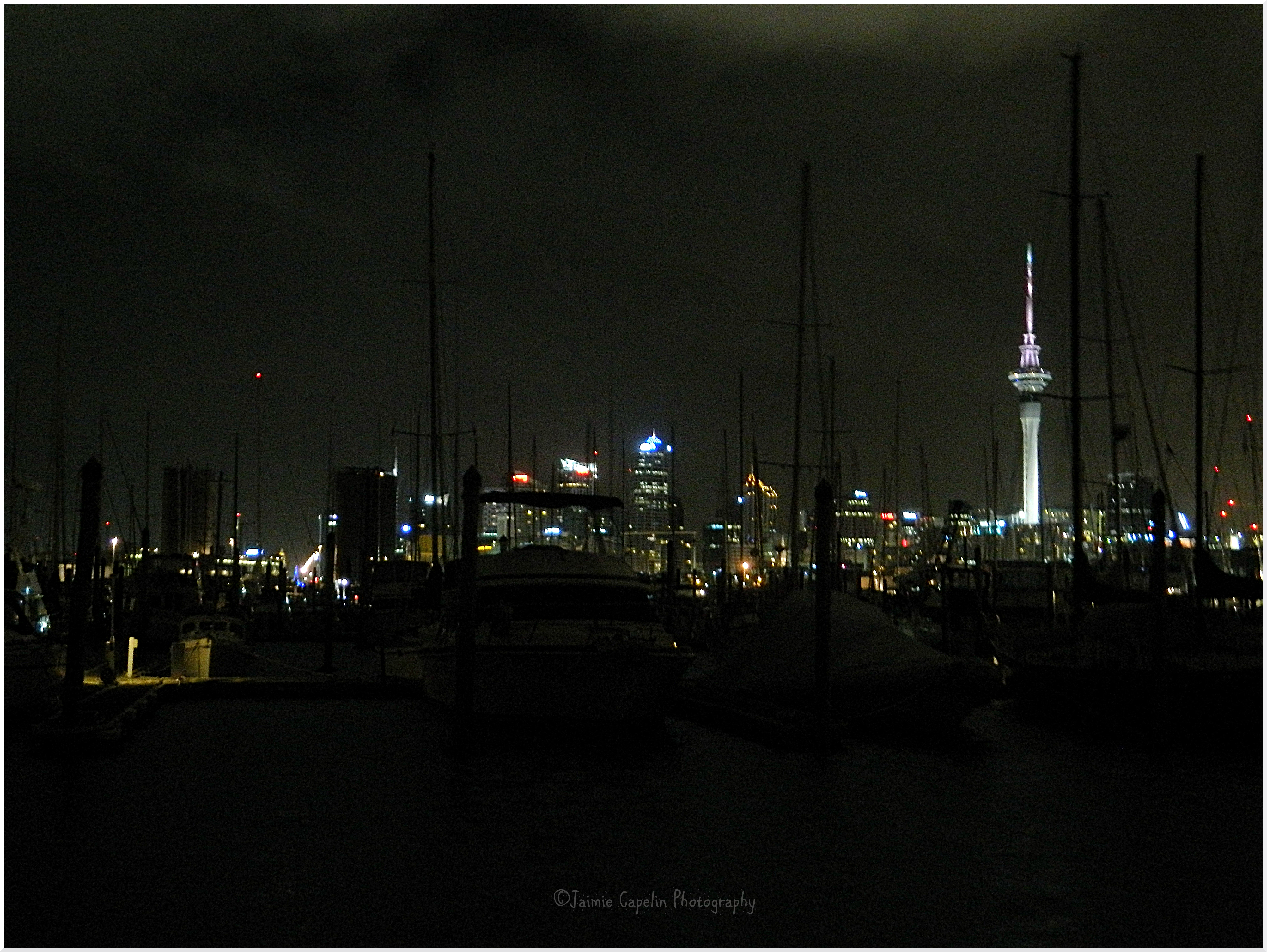
Okinawa, Japan – A Series of ‘Not Ideal’ Events

Okinawa is the last place I visited in Japan before flying back to the UK, and therefore the freshest to write about, which is why I have chosen it as my first Japan blog.

It is the biggest and most populated of the Ryukyu Islands, half way between mainland Japan and Taiwan in the East China Sea, and is home to Japan’s most critical American military base. Okinawa is quite different to mainland Japan, and wasn’t altogether what I expected…

I was travelling from Osaka city with two companions from the previous season, Taylor and Mic, and after several weeks of backpacking, all three of us were ready to sit on a sunny beach on a tropical island and relax. We’d planned our routes and times thoroughly, and were feeling pretty confident. Here, it is probably important to note that Osaka has two international airports, and they are nowhere near each other. Kansai Airport is where you’d likely catch a flight to Okinawa from, while Osaka International is the one Google Maps will default to, if you’re not quite specific enough… We went to the wrong airport.

A hair raising, hour-long taxi ride later, (worth more than the cost of our flight), we arrived at the RIGHT airport, about 3 minutes too late. The budget airline were able to put us on the next available flight, which was roughly nine hours later. So our first day in sunny Okinawa was spent in Kansai Airport’s domestic terminal. Not ideal.

Fortunately, nothing went wrong with our flight. The runway staff finished loading the luggage hold, stood in a line beside the plane, and bowed in unison, waving us off in true Japanese fashion as we taxied to take-off. Our flight took about 2 hours, with stunning in-flight views of the sunset, before descending over the twilit islands of Ryukyu. Our plan was to catch the bus into Naha city, near to where our pre-booked Air bnb was located. However, we’d arrived nearly 10 hours later than expected, and the island’s public transport isn’t very forgiving… We’d missed the last bus to Naha by minutes, and had already spent half a week’s budget on taxis that day, so, with a heavy sigh and some uncertain giggling, we adjusted our backpacks and began the two hour trek beneath the stars into the city.

At least it wasn’t raining. In fact, the temperature was noticeably warmer than mainland Japan, and despite the heavy luggage and worn out bodies, the walk was quite pleasant. We eventually reached our Air bnb, (via a supermarket for some instant noodles) and after a fairly disappointing shower, and an even more disappointing “instant” dinner, (which required the miniature kettle to be refilled three times), it was time to call it a day. Taylor went to close the sliding doors dividing the rooms, and found that only one door moved, sliding uselessly in the middle of the large door frame. He peered through the wide open gap, and let out a slightly maniacal laugh.

“That’s not ideal,” Mic said.
PhotoGrid_1525819526921

~ Kokusaidori Street ~

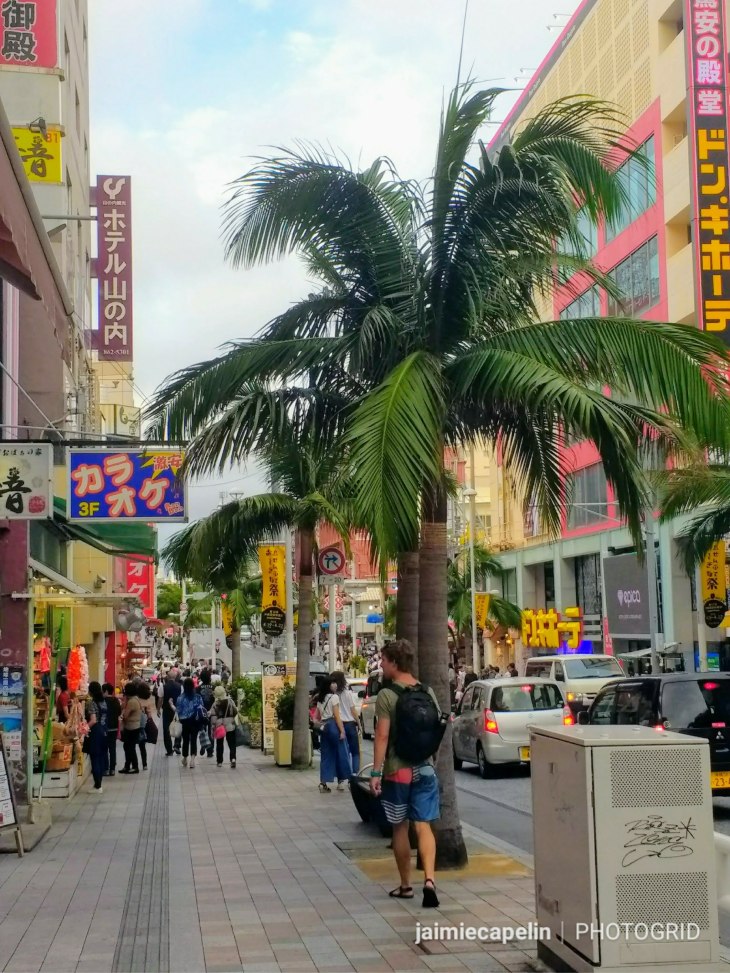
Morning came with the sound of birds twittering in the trees, and the shush of traffic a couple of blocks away. There was a bit of blue in the sky, and it was bright and warm. We drank the free coffee provided by the Air bnb, and took off down the road to the main international strip, about 10 minutes away on foot.

Kokusaidori Street – noise; both visual and audio – sales men and women attempt to catch your attention at every shop entrance, ornamental dragons in multi-coloured pairs line the displays in all shapes and sizes. Novelty toys, mugs, T-shirts, and generic holiday paraphernalia fill your peripherals as far as the eye can see. Enormous jars of habu sake, (rattle snakes drowned in Japanese liquor) stand in stacks, going for 400,000 yen a pop, the snakes inside hissing silently at by-passers. Fiberglass fronted restaurants boast of rare delicacies; puffa fish gawp out from tanks. We even saw a very small tank outside a seafood restaurant, with a live turtle in it – I quickly walked on and tried not to ask too many questions.

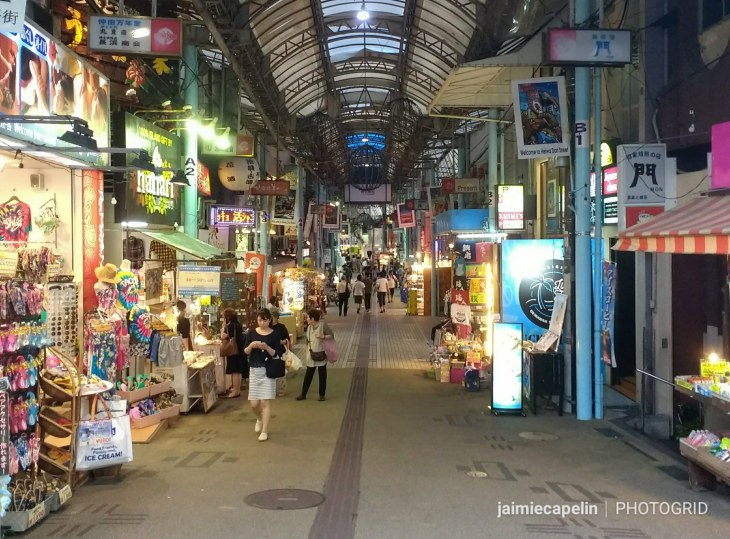
Following the street up, we turned off beneath the canopied Heiwa dori Street, through a network of arcades and alleys lined with street sellers, leading into the wonders of Makishi Market, where Okinawa’s strangest delicacies can be found. We stumbled upon the seafood hall by meer accident, filled with stalls and restaurants of all kinds. A grid of long tables laid out like an enormous canteen, played host to hungry punters, while lobster, squid, fresh fish, shellfish, everything you could imagine, was served on platters shaped like small boats!
PhotoGrid_1525819601886

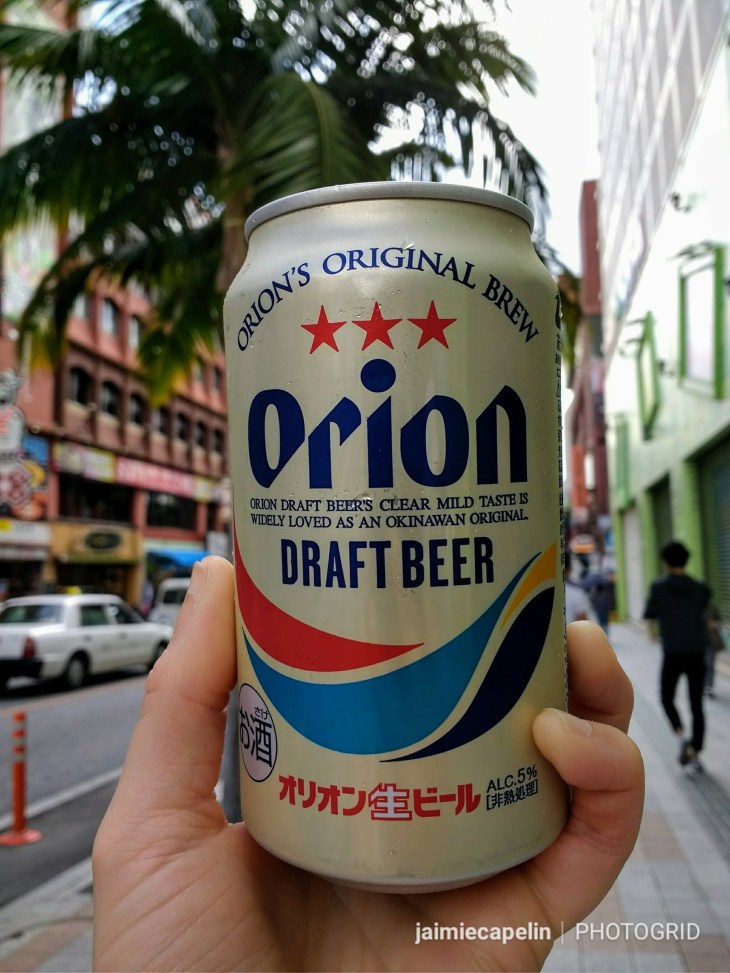
At the intersection marking the end of Kokusaidori Street, we discovered an underground food hall in the basement level of the Ryubo building. We browsed the deli counters, bakeries, fish mongers, and enjoyed a varied lunch, accompanied by special blend coffee, and topped off with some delicious Japanese beer from the world craft beer counter. Happily satisfied after a good feed, we headed back outside, eyes directed at the sky in hope of beach weather! Unfortunately it was windy and grey, (though we had no idea what was in store for us) so we continued to browse Kokusaidori street, soaking up the bustling atmosphere with a local ‘Orion’ beer in hand from one of the many Lawson’s convenience stores.
PhotoGrid_1525817480981

~ Shisa Dogs ~

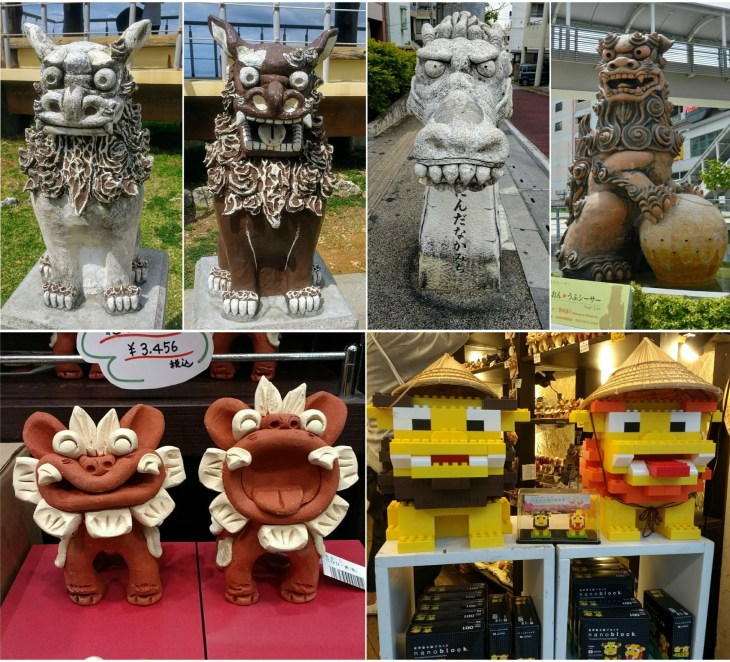
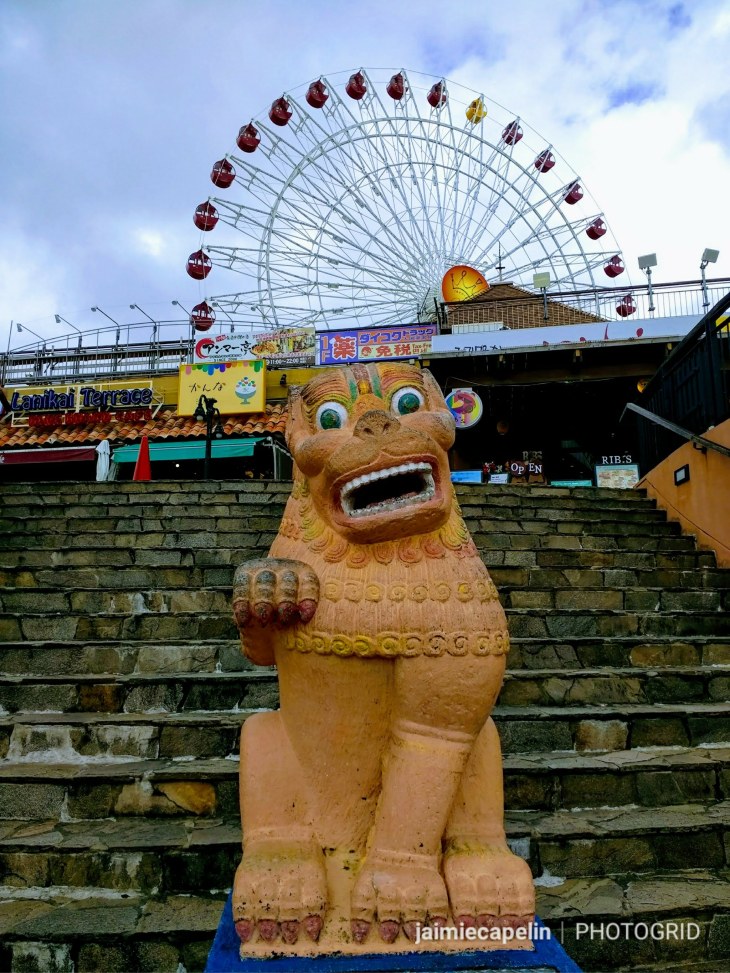
These goofy looking statues are everywhere, bearing similarities to Chinese Dragons, they are somewhere between a lion and a dog, and these are the little trinkets that fill every souvenir shop. Shisa Dogs are a Ryukyuan tradition from Okinawan folklore, believed to protect places from evil, and are often seen on rooftops, or guarding the entrance to most buildings. They always come in pairs; the right-hand Shisa Dog has its mouth open to ward off evil spirits, while the left-hand one’s mouth is closed to keep good spirits in. Often the pairs have cheeky facial expressions, and are depicted to be cheerful and amusing, sometimes painted in vibrant colours, reminding me of Disney’s ‘Stitch.’ The Shisa Dogs were one of my favourite things about Okinawa, giving the place a little touch of character.
PhotoGrid_1526156957197

~ Naha Beach ~

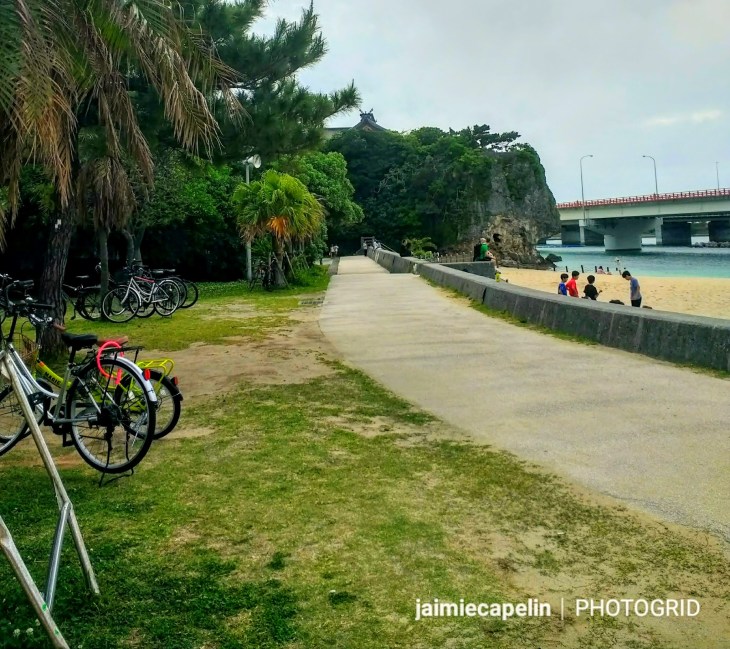
Advertised up and down the main strip as one of Naha’s hot-spots, it was quite amusing how unspectacular it was when we arrived! However, despite the small radius of beach, surrounded by concrete walls, and the noisy highway bridge crossing the water, the sand is clean and white, and the water is crystal clear. A sectioned off lido protects swimmers from box jellyfish, and a lifeguard patrols the beach. Trees fill the park behind, where dozens of stray cats frolic in the grass, prowling on picnics. The facilities also include toilets, showers, and even a hire shop for all your seaside needs, from parasols to inflatable tyres. Apart from sunshine, what more can you really ask for?
PhotoGrid_1525819483307

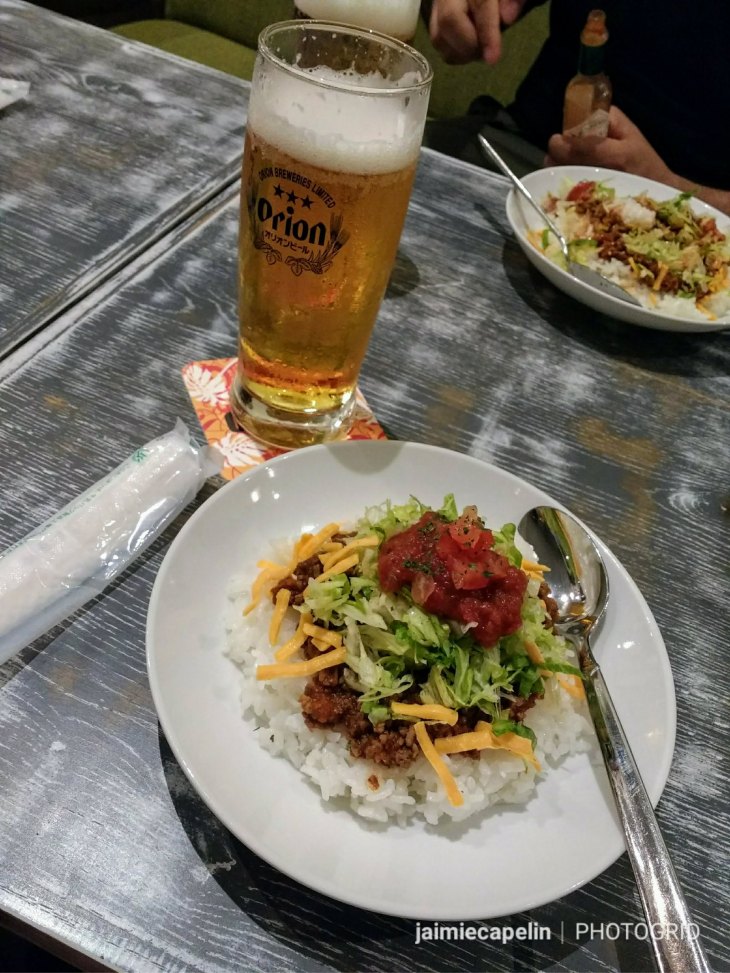
For dinner we found a pub serving Taco Rice – an Okinawan dish coining taco filling, and Japanese rice. Finished with a big dollop of salsa, it is a blander version of chilli con carne; a sort of Japanese/American compromise, washed down with a refreshing glass of Orion.
PhotoGrid_1525817300790

The night took us to a penthouse bar, where we couldn’t figure out what language to order our drinks in. With the only other customers being American, and the bar girl responding to my broken Japanese in English, I felt like a proper tourist! The boys smashed out a game of Foos ball, I destroyed a game of jenga way too early on, and we all found out the hard way that you should never strawpedo Guinness!

~ The American Village ~

It’s super easy to hire a car, as long as you have your international driver’s license, passport, and a better sense of direction than us. We went to the airport on the monorail – which loops Naha city on a regular basis throughout the day time – to find the best selection of car hire. After walking around the terminal, looking in all the wrong places, we couldn’t for the life of us find a car hire desk! Of course, it was really easy, slap bang in the middle, impossible to miss, and once we got there, we simply picked our price range, chose our insurance policy, and hopped on a shuttle to the depot. After a quick exchange of details and money, we were given our car – a little white cube on wheels. These little Japanese cars don’t have much of a kick, and the top speed limit in Okinawa is 60kmph, which makes driving very economical and cheap. As there are no trains around the island, and buses can be irregular and expensive, hiring a car is definitely the best value for money.
PhotoGrid_1525817518881

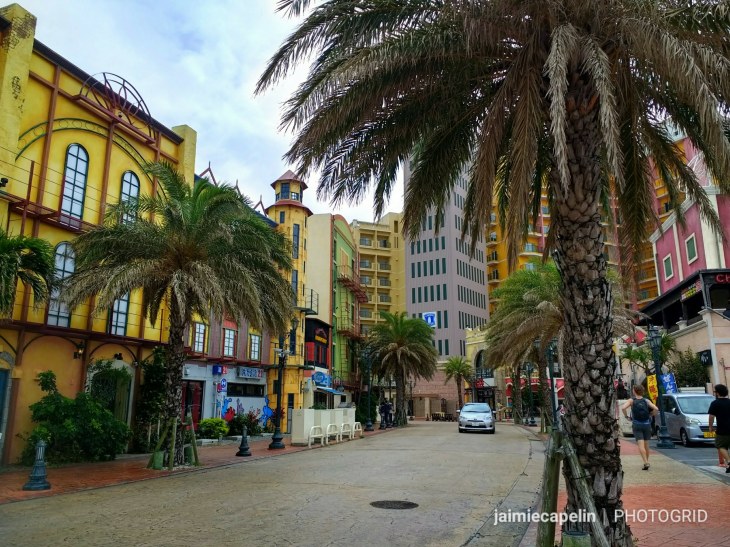
Heading north, we joined the highway out of the city. The landscape rose and fell, every inch littered with white and grey tower blocks, as though several boxes of starwars lego had been emptied across the land. As we approached the American Village, fast food restaurants began to pop up by the dozen alongside the highway; McDonalds, KFC, Dominoes, Denny’s, and so on and so forth. Pulling up in the village, it was like stepping out into one of those replica towns at Disney World – each building with a brightly painted facade, and palm trees spaced neatly between perfect paving slabs.

Making a bee line for coffee, we entered an arcade of cafes and restaurants along the waterfront promenade. We were welcomed at the door and shown to our seats in American fashion, by a smiley, English speaking waitress, where we enjoyed perfectly rosetta’d lattes, watching the moody weather roll in off the East China Sea, and quietly wondering whether we were supposed to leave a tip, or if like the rest of Japan, it was considered rude…
PhotoGrid_1525819360922

The village is a jumble of American style burger shops, cafes, and tack shops selling American souvenirs. There is a ferris wheel on top of a building filled with arcades and novelty shops. White sand bays surround the village, where we dipped our feet in the warm water beneath an ominous black sky.

Driving out of the American Village, we passed ‘Round One’ – a chain of indoor arcades and sports activities. An entire level is packed with arcade machines, pinging and popping and singing, lights flashing, enormous cuddly Pokémon willing you to defeat the impossible and win them! We decided to stick with the day’s American theme, and played ten pin bowling. Not until we’d begun our game did we realise we were supposed to hire bowling shoes from a vending machine. Yes, a vending machine! Oh well, that saved a thousand yen – Gaijin card well played… Oops!

~ Island Hopping ~

There are tonnes of little islands off the coast of Okinawa that you can take day trips to via ferry or plane, and they are said to be stunning. Unfortunately, we were on a budget, and the weather forecast was looking a bit temperamental – the ferries are known to stop running if there are any signs of bad weather. So for fear of being trapped on a desert island in a storm with no money, (and the way our luck was going, the chances were high) we made a mutual decision to go and explore some closer islands, accessible by bridge.

We headed north-west, the sun behind us, and eventually came to countryside! The concrete jungle fizzled out, and we could see the sparkling ocean ahead, our hopes alive for finally getting our tropical island swim! We even stopped at a Lawson’s and got a picnic for our glorious beach day, and could already smell the salty air and sun cream in anticipation.

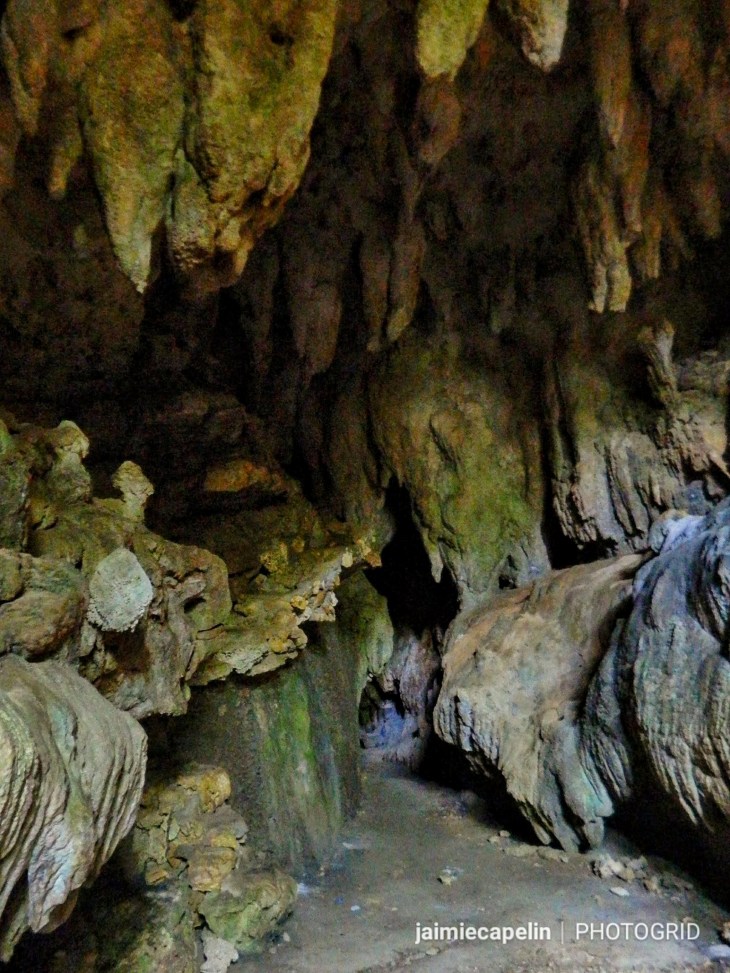
Crossing our first bridge onto the tiny Yabuchi Island in the Uruma district, the road narrowed into a winding dirt track, leading seemingly to a dead end. Parking up, we continued on foot, and just through the trees we found the entrance to Janeh Cave. 6500 year old arrow heads made of shell were excavated here in 1960, along with claw-shaped pottery. These finds suggested that sea routes between Southern China and the islands were extensive much earlier than first thought.
PhotoGrid_1525859797187

We entered the cave, stalactites looming down on us; fossils jutting out of the rock. You can see gaping squares in the ground, strewn with tarpaulin, where archaeologists have scarred the ancient rock. Deeper into the cave and the temperature dropped. Cool moisture clung to my skin, and that eerie feeling came over that makes the hairs stand up on the back of your neck. We tried to hold our ground, egging each other on to peek around the next pitch-black corner, but it got too narrow; the shadows too surreal, and so we went back to the light.

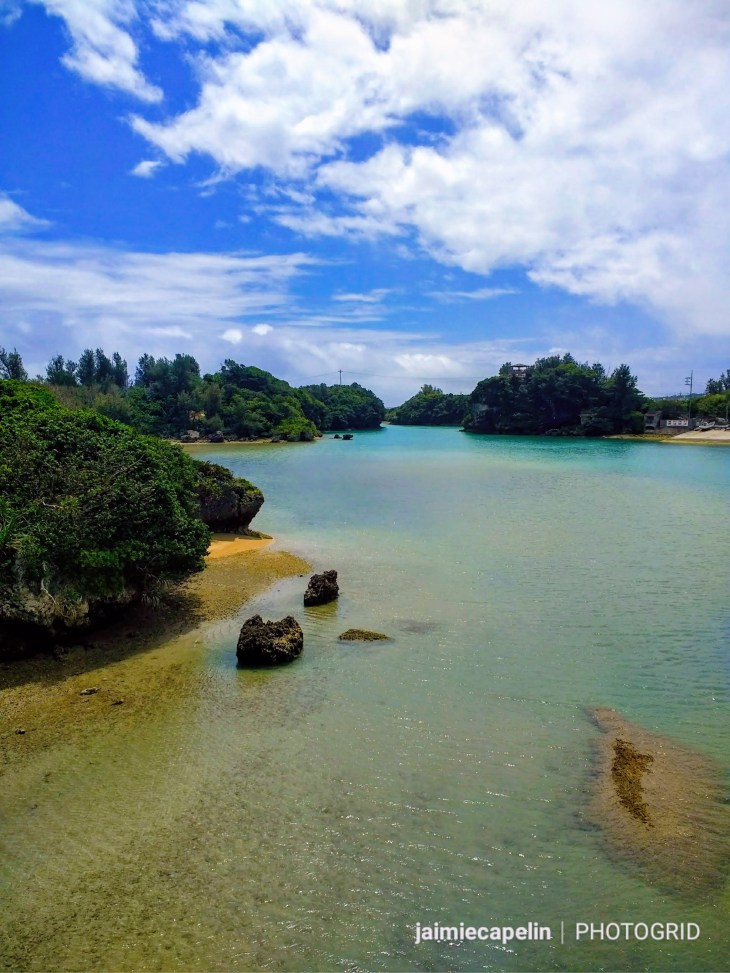
Pretty coves surround Yabuchi island, with volcanic rock formations jutting out the edges of the turquoise sea, where bridges stretch off in different directions. Though it was beautiful, the spikey rock made the water inaccessible.
PhotoGrid_1526138548515

Then, all of a sudden, it was raining. Fine, wet rain, which had the three of us sheltering under an arch of rock, rolling our eyes. Certainly not ideal. We ran back to the car, and searching for a rainbow as the sun burned through again, we made our way to the next island.

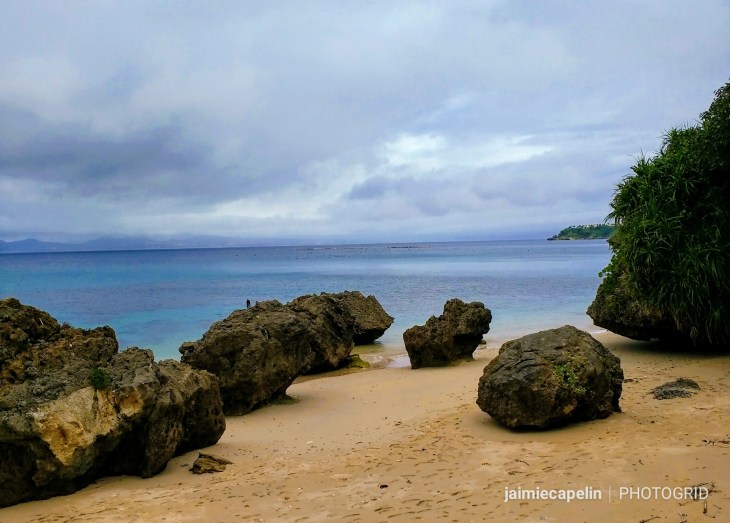
A long bridge takes you to Henza island, which is mostly industrial land, belonging to the Idetsu oil company. Henza leads on to Miyagi and Ikei, which are home to many tourist beaches, the first being Tonnaha Beach, in the north-most cove of Miyagi Island. A track leads down to a seawall, beyond which is more white sand and clear sea, decorated with coral and picturesque rocks. We watched hermit crabs scurry about on the sand, playing peek-a-boo from their colourful shells. An oil rig sits off-shore of Tonnaha Beach, obscuring the silhouette of Okinawa main island across the sea in the distance.

Another bridge and another beach – Ikei Beach – which we had to access through a building. A lady came out and welcomed us, asking for 500 yen per person to enter the beach… many of the tourist beaches in Okinawa are pay-on-entry; a concept we couldn’t get our heads around, growing up with the freedom of having beaches on our doorsteps. The sky wasn’t making any promises, and it was beginning to drizzle, so onwards we went! Every beach on Ikei Island was asking for money just to enter, and with the weather on the turn again, and most of our picnic already eaten, Mic suggested finding a seaside coffee shop and watching the rain.
PhotoGrid_1526228033075.jpg

On our drive around the islands, we saw many impressive tombs, unlike the burial sites in mainland Japan. Often randomly placed, like on the edge of a crop field, or next to a convenience store, they are grand and haunting. ‘Haka’ tombs are unique to Okinawa, though their origins have been traced back to ancient Southern China; designed to be like houses for the departed, sometimes we’d see an enormous cluster of tombs, where an entire family is laid to rest, little offerings like bundles of herbs or flowers laid down at their doors.

The final island – Hamahiga – linked off the south of Henza Island, had so much potential, had we been there a month or two later. The coffee shop we’d aimed for was still closed for the down season, and the only other people we saw were a group of workmen, who all stopped and waved enthusiastically as though they hadn’t seen anyone for days either! At the end of the island we came across a salt factory, with a beautiful hidden bay beyond. We even considered going for a swim in the rain, but agreed that we’d only be doing it for the sake of it, so, feeling quite fed up, we hopped back in the car and drove back towards Lawson’s for a cold coffee out of the chiller and wifi.

Then the monsoon came. It hammered the windscreen so we could no longer hear the music. The wipers flailed manically, but couldn’t clear the view. Traffic had slowed down significantly, the road spray preventing anyone from seeing the vehicle in front, or the road for that matter. Tyre-deep flash floods appeared from nowhere, and all vision was a wet, monochrome blur. Beach day was cancelled.

We took ourselves back to Naha, where we waited for the rain to ease off before going to a local ramen restaurant for dinner, but by the time we’d finished eating, the storm was back with a vengeance. Floor-length skirts and flip-flops in ankle-deep water is definitely not ideal, I was trying to say beneath the drumming on my umbrella, while cars splashed by causing mini tsunamis. It was time to go back to the apartment and drink wine, while the crack of forked lightning echoed across the night sky outside.

~ Zanpa Beach & Maeda Point ~

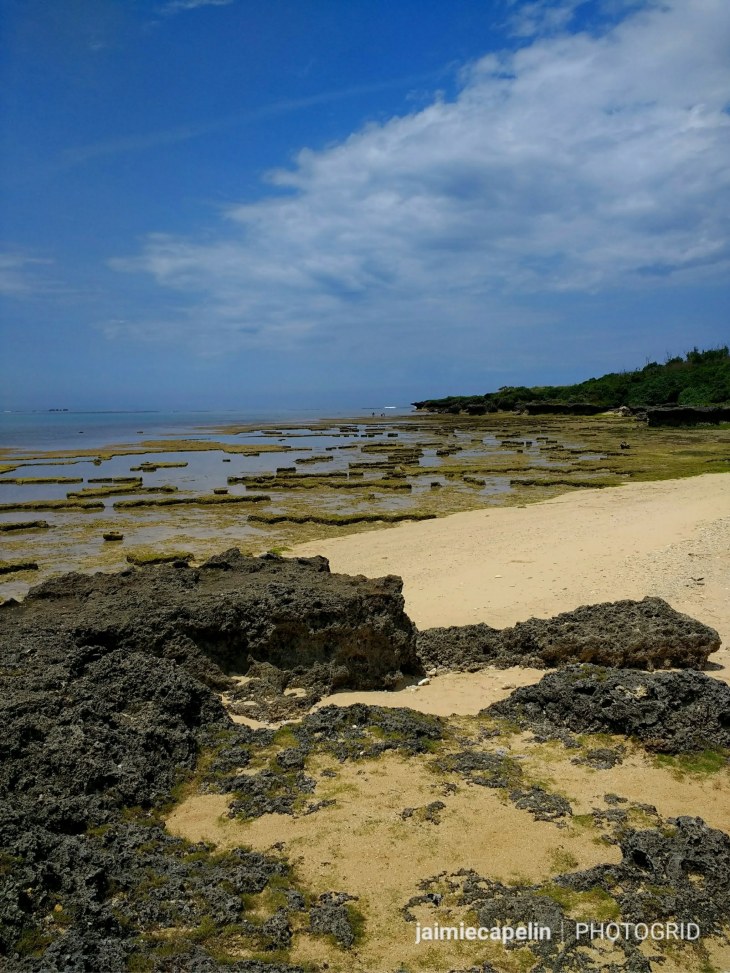
Morning began late, with a heavy head from a glass too-many of wine, but the sun was shining fresh after last night’s storm, and I was feeling like a weight had been lifted from my shoulders. We were on the road to Cape Zanpa, and Maeda Point – I volunteered not to drive, so Mic took the wheel while Taylor and I kept ourselves quiet with a cheeky McDonalds, like two happy children. We passed The American Village around halfway, and continued up the coast, past large American bases; their big, white bungalows fenced in with barbed wire. At first, we continued past Zanpa Beach, assuming it was another pay-to-enter resort, and found ourselves in the neighbouring bay, looking at an array of coral reef formations, like the foundations of ancient building remains.
PhotoGrid_1525819431567

Mic made the journey across the reef to test the water, and in the meantime, Taylor and I sussed out Zanpa Beach, realising that we could access it easily without any sign of having to pay. So there we went. The grasslands above the beach were laden with public BBQs, probably thriving with off-duty military men and their families in the summer months. The beach itself hosted a number of water activities – you could hire paddle boards, kayaks, jet skis; have a go at tubing or even try one of their jet packs. It had a swimming lido, as most tourist beaches do, to protect from dangerous jelly fish, and the lifeguard sat on his plinth, observing under blue skies. It seemed too good to be true – the sun was gleaming down; the sand was hot and the sea was cool. Towels laid out ready, the three of us ran into the ocean, (you can almost hear the slow-running music playing in the background) and we swam and floated about, while fish darted about our legs. Drying in the sun, I laid on my towel, hangover washed away by the ocean, and finally felt like I was on holiday. It was ideal!

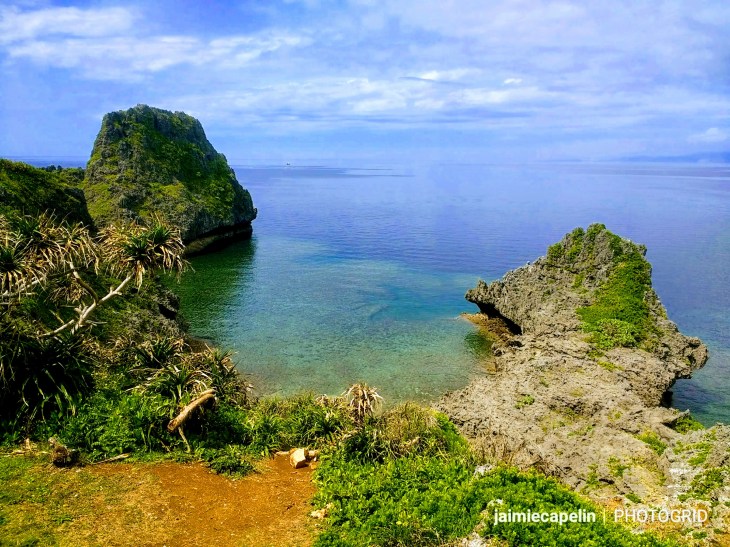
Once dry and crispy from the sun, we got back in the car and made a point of going to Maeda Point… (sorry). Cape Maeda was exactly what we’d been looking for, with quirky little coffee shops and authentic restaurants. There were little beach-town houses rather than tower blocks, and pretty, natural bays with no expensive resorts or lines of parasols. Following Mic’s satnav instructions, I drove along a track to a car park, where we got out and followed a line of scuba divers down the footpath to Maeda Point. A viewing podium leered on the edge of the cliff, protected by two Shisa Dogs, looking out onto a most stunning cove, smothered in reef.
PhotoGrid_1525819460008

Below, groups of divers and snorkelers explored the sea life at the water-logged entrance to the renown Blue Cave. I think the three of us could have stayed there all day, but the hire car had to be back at the depot by 5pm, so we made our way reluctantly back to the city.

Dinner was a treat. It was Taylor’s last night in Japan, and he chose Okinawan seafood down in Heiwa dori Street market. We went for some of the tamer dishes on the menu, (as opposed to boiled fish eyes and tuna gizzards) which were freshly and expertly prepared to order within the shop. I was pleasantly surprised, tasting the rubbery squid tentacle, salmon sashimi, and tasty tempura tuna, and we ended up getting seconds of the delicious grilled tuna! That was definitely worth making our wallets lighter.

The remainder of my time in Okinawa was mostly reserved for packing, and after bidding Taylor farewell, we prepared for our individual onward journeys. Mic and I shared a last meal on the island, at one of the Okinawan restaurants along Kokusaidori Street, where we tasted some classic local produce. It is very similar to Japanese food, but with an island twist – egg and tofu with bitter melon – a kind of peppery celery that looks like a snozzcumber, but adds a lot of flavour and crunch to a dish. We had Okinawan dry soba, which was enriched with chicken and vegetables, and a side of pork fat potatoes.

Despite many ‘not ideal’ moments, Okinawa was an enjoyable experience – certainly different, and quite amusing in hindsight! If I found myself there again, I would hire a car from start to end, and consider staying in a few different locations, leaving space to go to some of the other off-shore islands… And stock up on Orion beer for when the monsoons roll in!


Sailing to Smokehouse Bay

Gunpowder, Treason & Plot

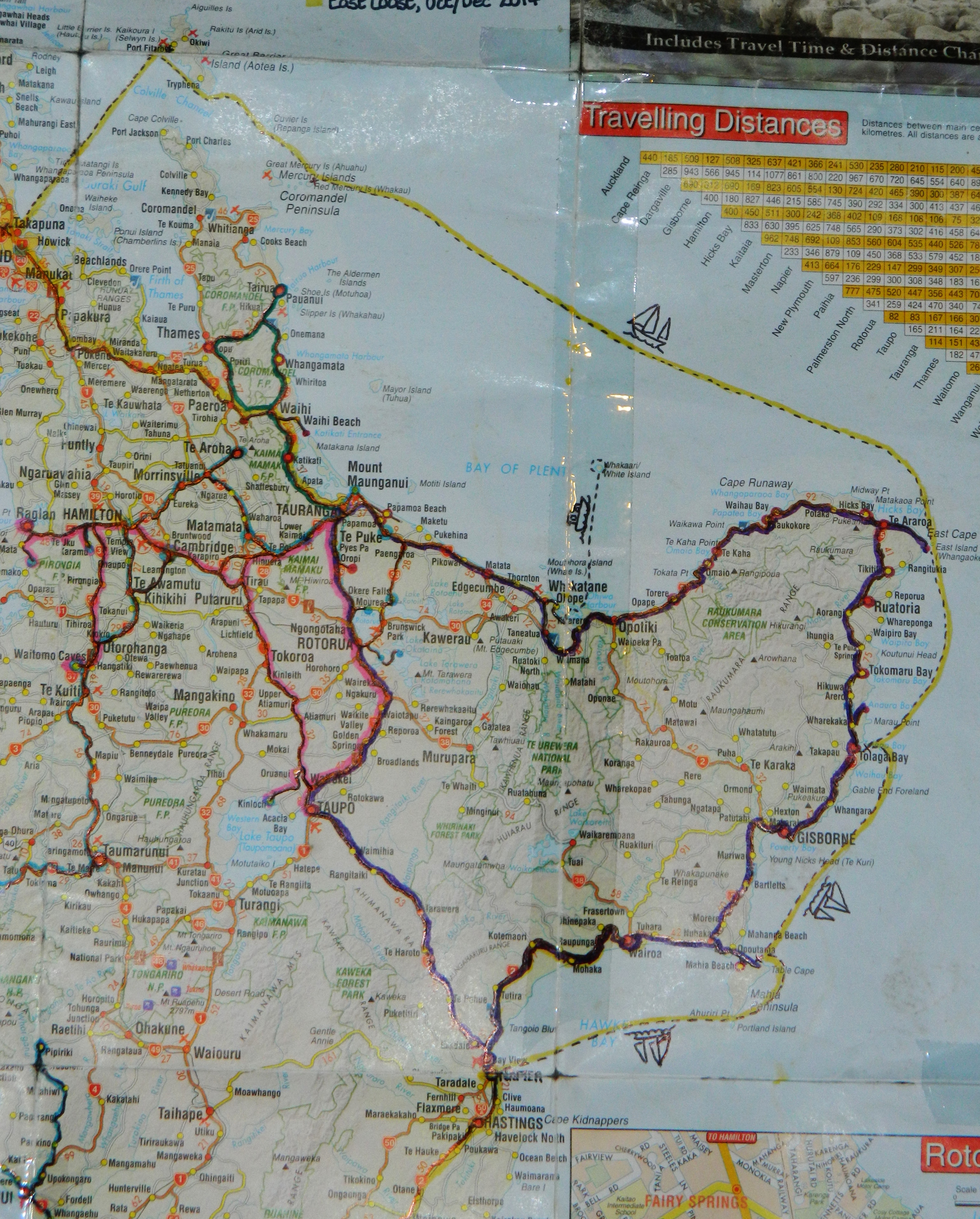
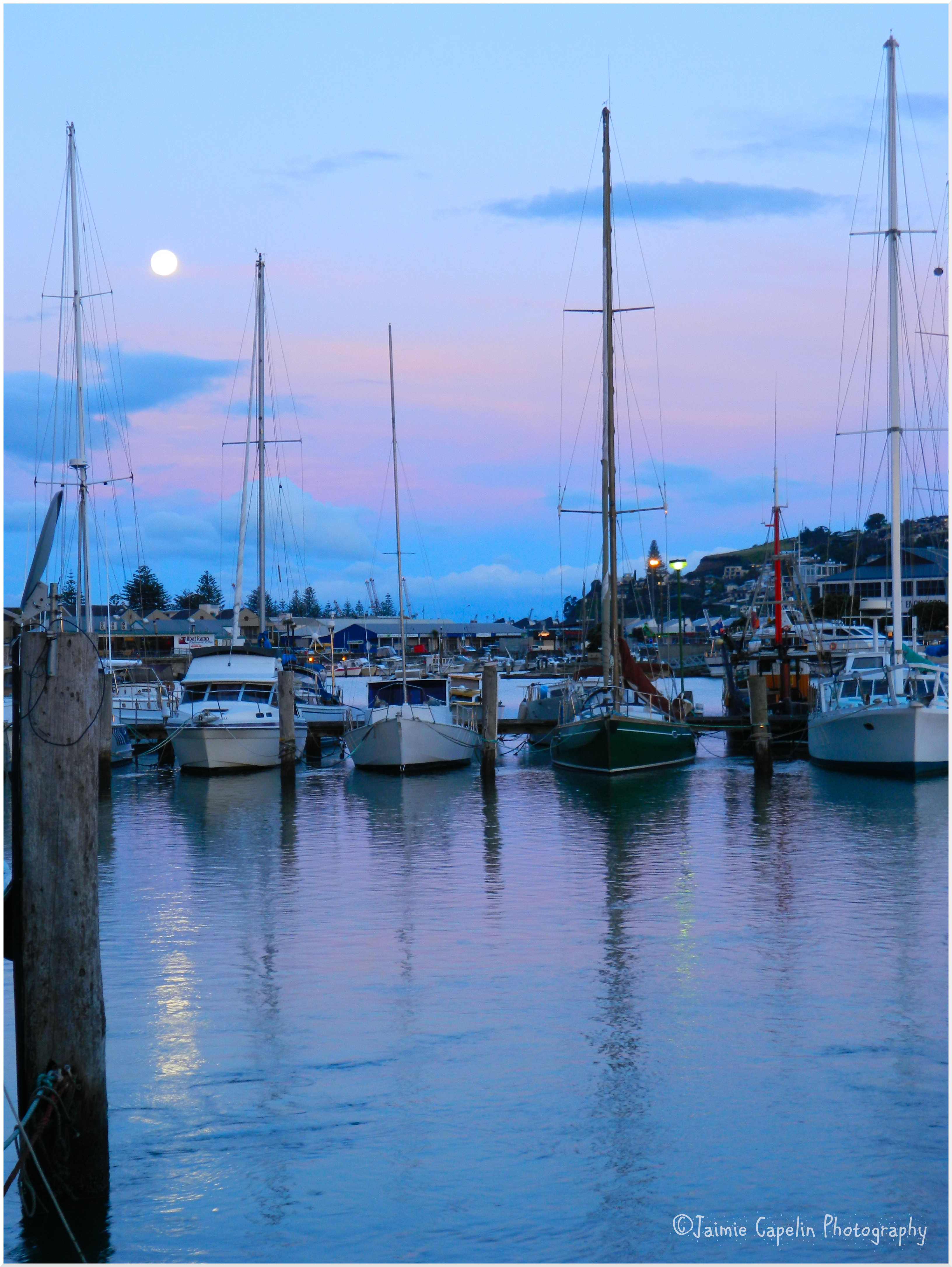
It’s the night of November the 5th. Bonfires line the beach like beacons from Hastings to Napier, and we laugh and drink under a drizzling, red sky. Finn hands out fireworks to his new companions, and the brave ones shoot them upwards, like young wizards defending their school. In two days, we are to set sail on Finn’s boat from Napier to Aotea – The Great Barrier Island, and then on to Auckland.

Finn is a local Napier boy, who has sailed hard to get where he is today at the age of 22. His friend Kyle is American, an experienced sailor, and the two met working as sailing instructors in the Caribbean. My first impression of Kyle was that he kind of resembles Leonardo DiCaprio, but I pushed aside any Titanic references circling my head. That makes up the 30% of our crew who can actually sail!

Then there’s us – the couch-surfers. Dani is a bright and bubbly chick from München; Fabian is a food passionate from Stuttgart; Luca is the quiet one from Köln, and Simon is an artistic dude from Bavaria. Then there’s me, the Pom.

Napier Harbour Moonrise

Napier Harbour Moonrise

The Dulcinea

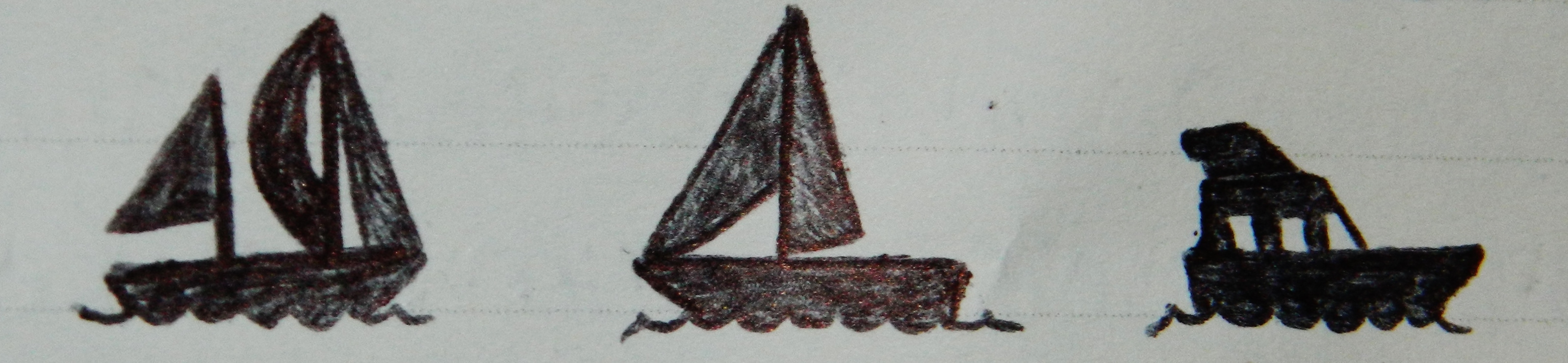
The Dulcinea is a 44ft Steel Ketch yacht with 2 masts. She has three sails: Jib – front; Main – middle, and Mizzen – rear. She sits just 2m below the surface, and her led-weighted bottom makes her a ‘Knock over’, meaning no matter how much she keels she is near impossible to capsize. The Dulcinea was custom built in California in 1986, and was sailed across the Pacific to New Zealand by Finn in 2013. She can sleep up to 10 people, but 7 is cosy enough.

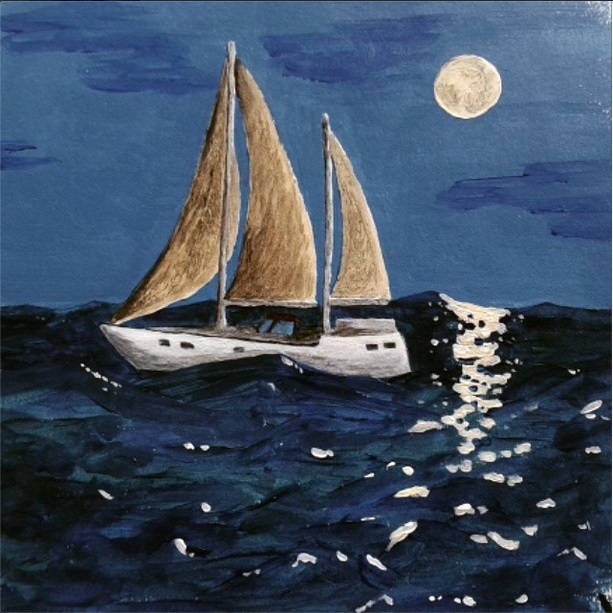
'Night Sailing' - one from my sketchbook

‘Night Sailing’ – one from my sketchbook


Bananas On Board
7th November

Today we set sail, leaving Napier midmorning after the boys went for a HUGE shop. Before we left, we ate all the bananas that had been brought on board, because it’s bad luck to sail with bananas. Kyle told us that when shipwrecks were discovered, bananas were the only things they could salvage, floating around amongst the debris, so the general consensus became that bananas were bad luck. Also, they were known to bring cockroaches and rats on board, spreading famine.

As we prepared to leave the harbour, we met a character on one of the neighbouring houseboats. He is an old Maori fella, who has lived on his little boat for years. The fascinating thing is, he is blind. Kyle heard him calling out to us, “Is that Finn and his crew? You off today?” The old man got chatting about the goings on in the harbour – the other boats being washed and maintained and who’s boat was where. He knew everything just by the sound, and he moved around the harbour as though he could see perfectly well.

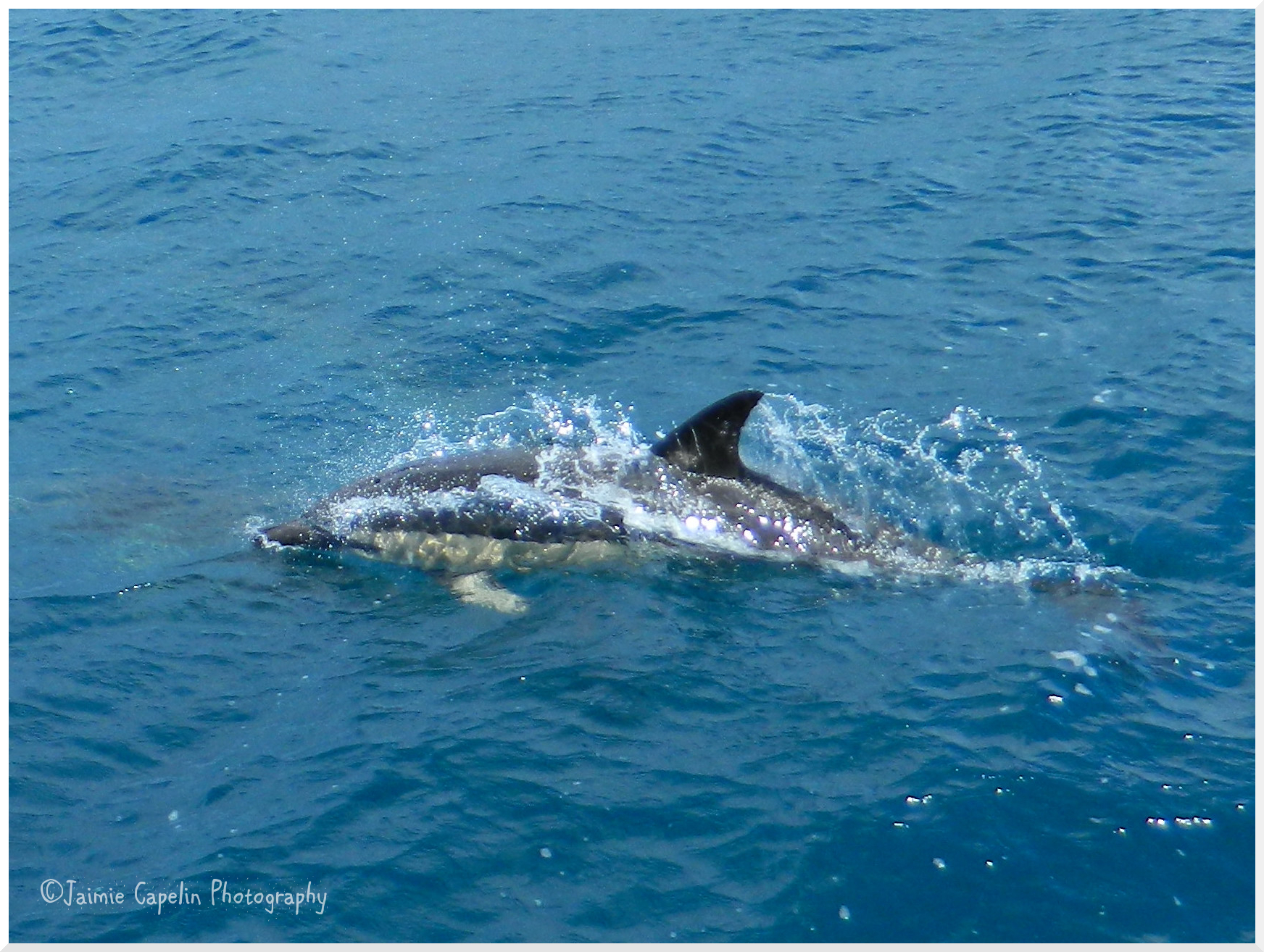
We are heading N.E, destination East Cape. We’ve seen gannets and dolphins already, cruising alongside the boat as we passed their feeding spot. The sea is rolling, but the weather seems to be holding so far, with sunny spells and a light wind.

Dolphin Offshore Napier

Dolphin Offshore Napier

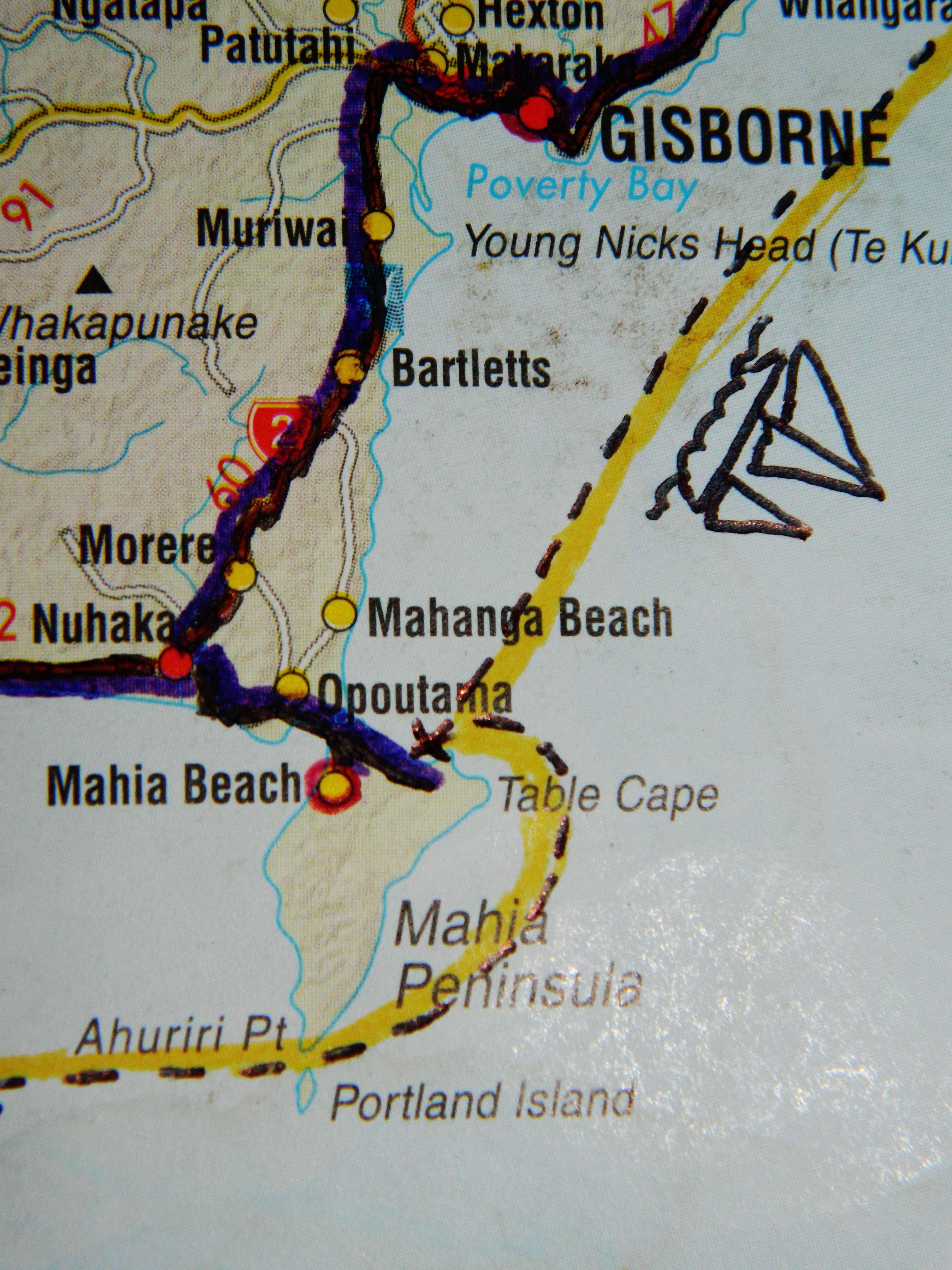
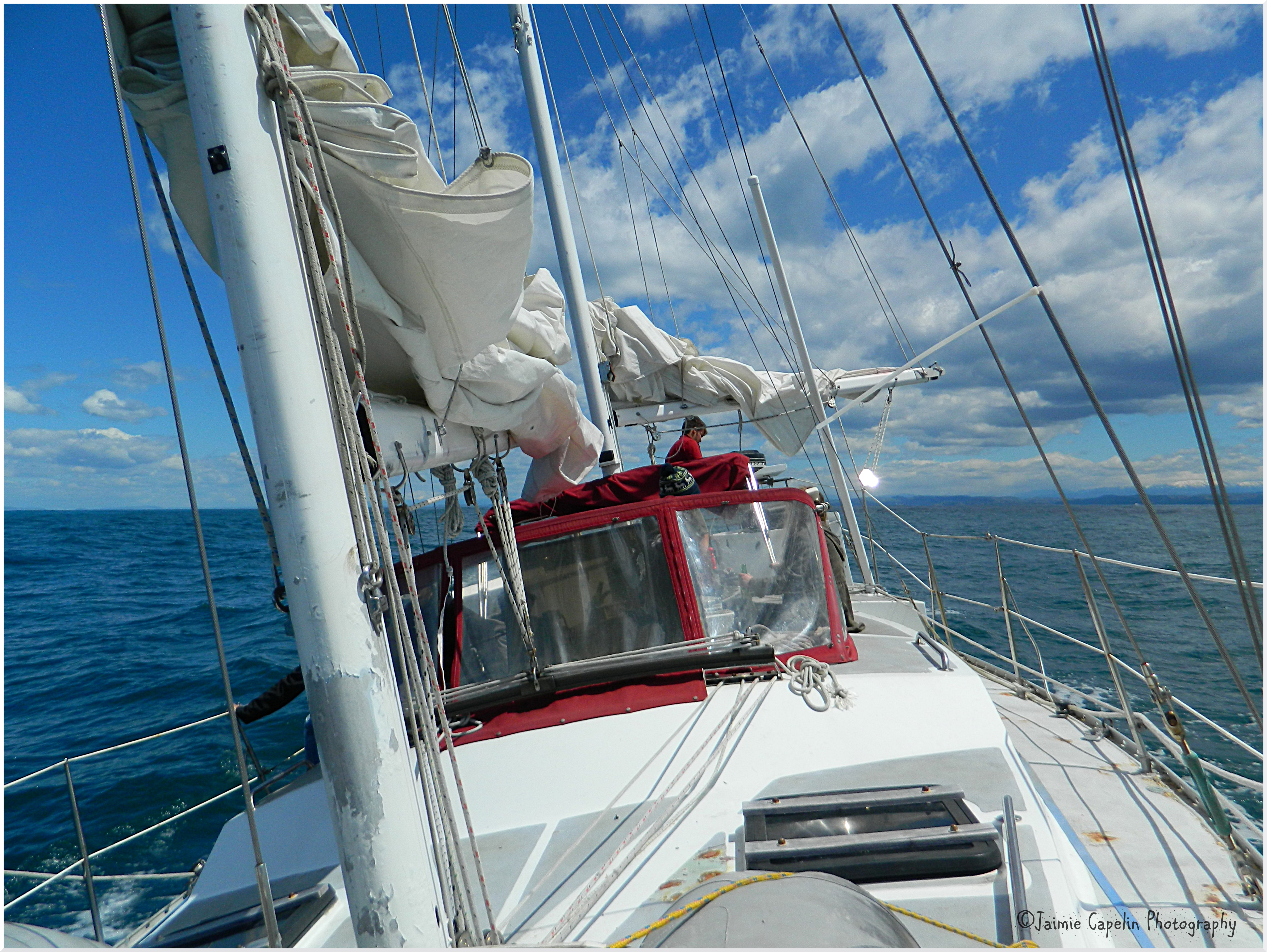
DSCN0235Mid-afternoon. It is quite rough, half the crew are seasick. We had to navigate shallow, rocky waters between Mahia Peninsula and Portland Is. The swell was huge, making the enormous waves vertical. The boys are spewing alternately off each side as the sails pop and the boom swings. Dani and I seem to be fairing pretty well, enjoying the ride, if not a little sunburnt. Albatross have been following us most the way; spectacular birds that swoop and run along the surface of the waves. Fabian is particularly taken by them. He’s been at the bow for hours, watching and photographing them.

A long 8 hours of sailing and we’ve finally dropped anchor in a small, sheltered bay between Mahia and Gisborne. Fabian has cooked rice and mince with veggies and the guys are having a few beers and playing cards. Finn’s teaching the crew how to play a card game called Presidents and Arseholes – a bit of a sailing tradition for him – and they keep yelling ‘SCUM’ at one another. The Germans are pretty good, naturally. Tonight the moon is like a burning nectarine rising from the horizon.

Rolling on the Swell

Rolling on the Swell

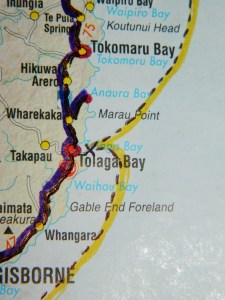
Tolaga Bay

After a late start yesterday, waking up to the likes of Six60 and Katchafire, and a breakfast of scrambled eggs, we sailed past GDSCN0236isborne and up towards the East Cape. The sea was still fairly lively, and the bitter south wind blew so we were able to sail at a fair speed. The boys were much better after a night’s sleep. We all settled on deck, Dani engrossed in her journal, while Luca, Simon, Fabian and I discussed such things as the pronunciation of the German ‘Z’, and I learnt things like, “Wie spät ist es?” and “Das Boot ist am Ozean.”
Kyle opened a packet of dry ramen (instant noodles) and started breaking it apart and crunching on it, to which Luca’s gaze was transfixed. Shortly after, Luca had a packet of ramen and was emptying the sachets of flavouring over the raw slab, lamenting at what a good idea it is!

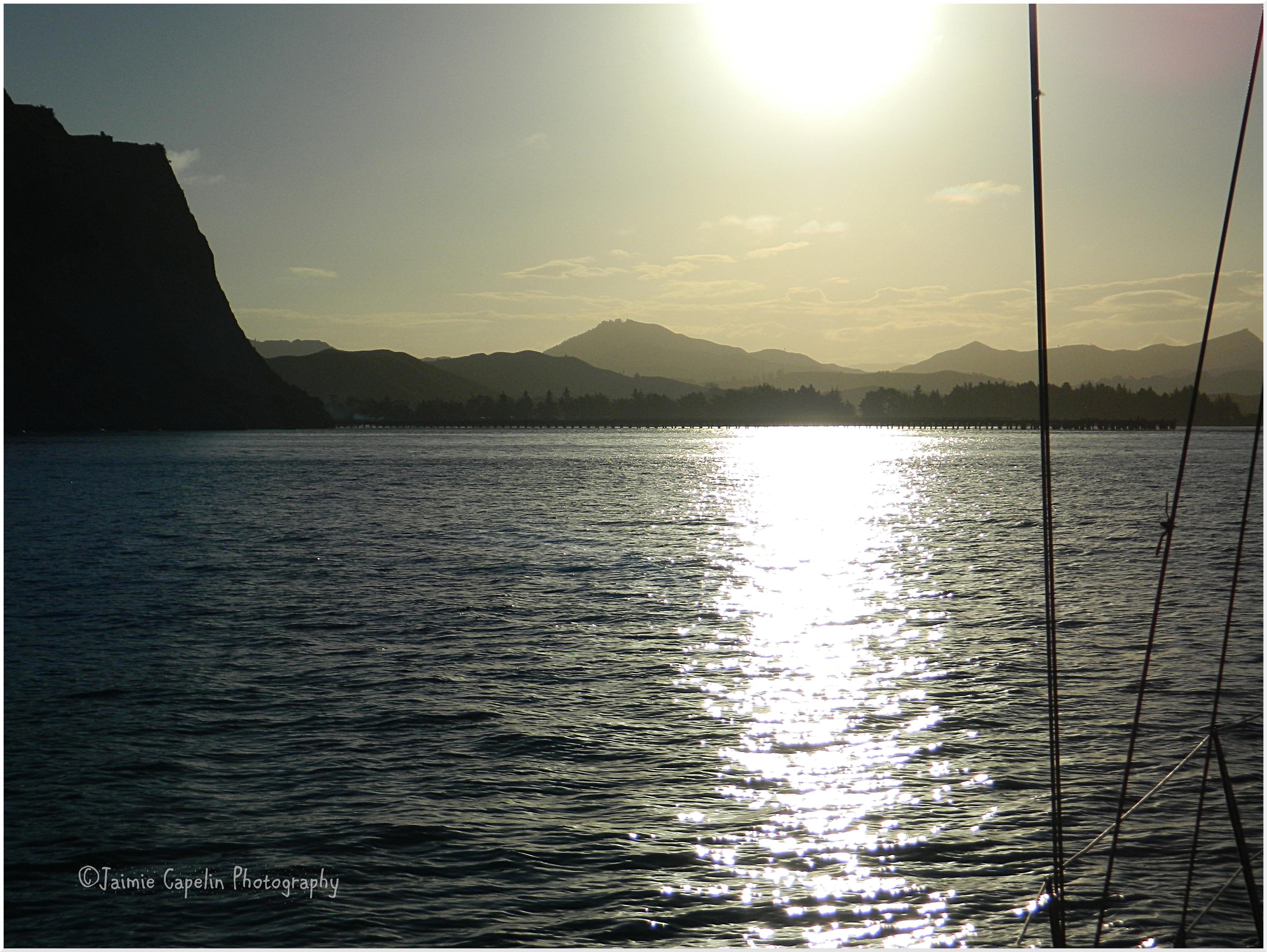
We anchored at Tolaga Bay around 6:30pm and got the BBQ fired up. A beer by sunset and steaks on the barbie, Tolaga Bay pier silhouetted in the silver sunlight.

Tolaga Bay Pier

Tolaga Bay Pier

It was a rougher night than the last, but it’s something to get used to, as we’ll be sailing through tonight. This morning we arose early, everything stiff and aching, but 5 minutes on deck, calmer waters, cuppa tea in hand and the smell of bacon coming up from below, and everything felt bliss again. The occasional dolphin or albatross passes by, but mostly there’s just shimmering ripples and sunshine.

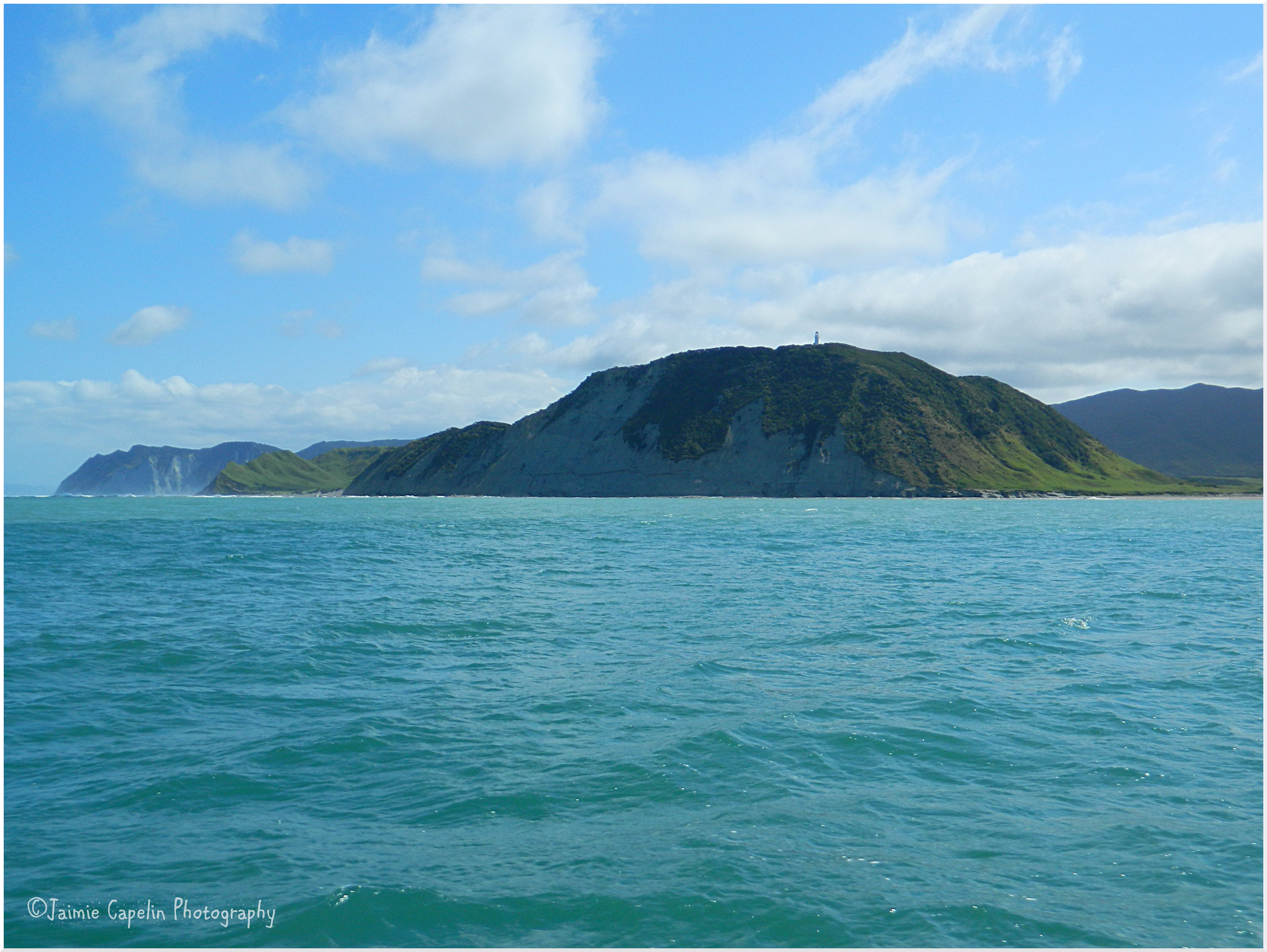
We made our way around the East Cape by mid-afternoon today, sailing between the lighthouse and the island. It looked pretty incredible from the sea, with dusky layers of landscape framing the skyline.

East Cape Lighthouse

East Cape Lighthouse

The engine’s sprung an oil leak, so we’ve been plain sailing while Finn fixes it. As we passed the East Cape lighthouse the wind died completely so the boat was just sitting, slowly turning with the current. Fabian jumped on the ropes, pulling the Jib sail round to find the wind. He made some difference, but for the first 10 minutes we were just going round in circles with Luca yelling, “Turn right! Turn right!” Eventually, Finn’s head popped up and directed Fabian, telling him to sail straight out east, or the wind would make us stall if we tried to sail directly into it, and soon enough, Fabian was sailing successfully!

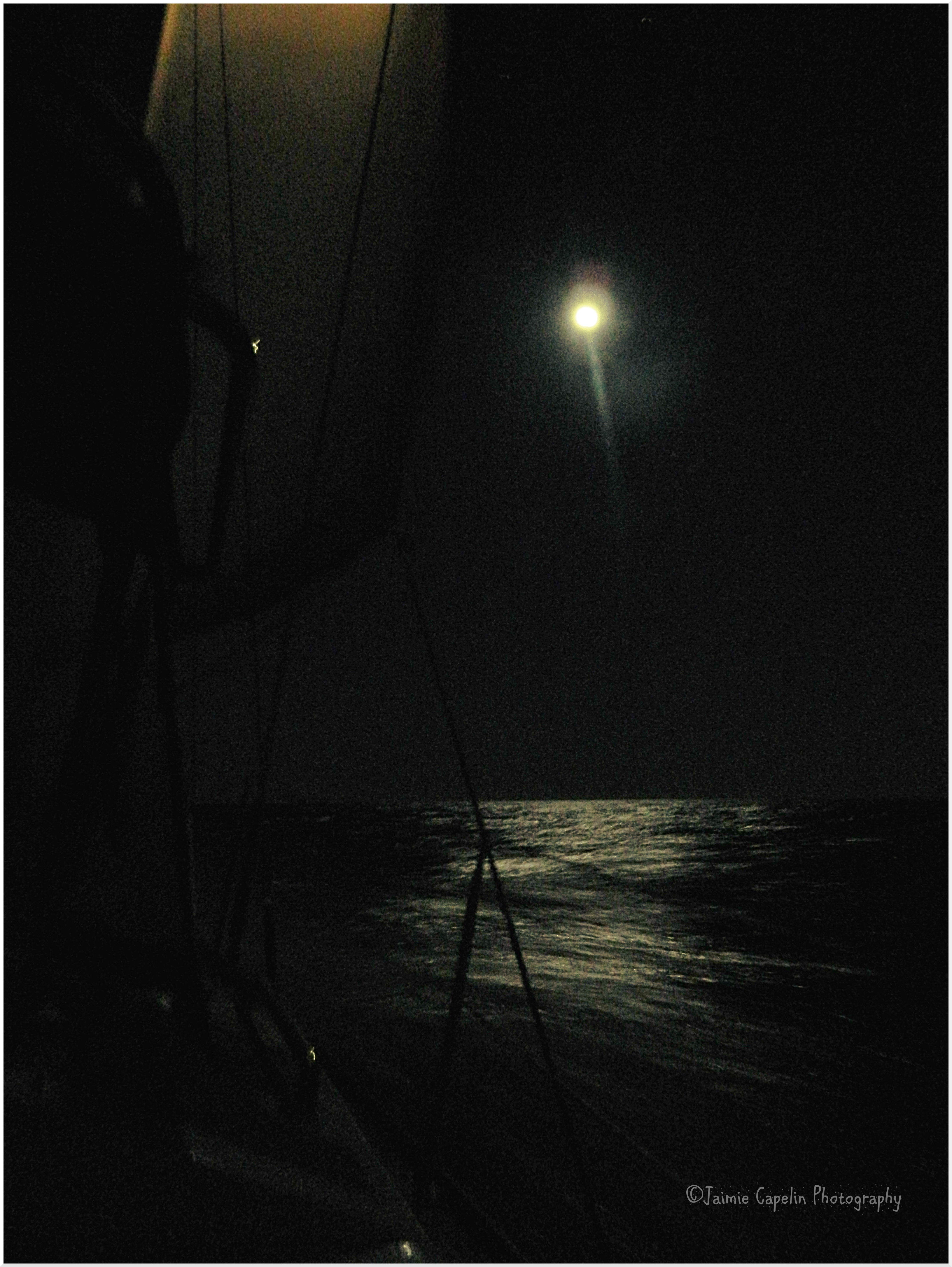
Sailing by Moonlight

It’s been a long night with broken sleep. Finn and Kyle have been taking watch, swapping every 2 and half hours, while the bright moon lights up the ocean and the Southern Cross shines above. I’d be lying if I said it’s a tranquil experience – with music playing all night, waves slapping the boat about; sails flapping and banging and the motor roaring away down below. None the less, we’re growing accustomed to the rolling and roaring and sleep comes in dazed installments.

Sailing by Moonlight

Sailing by Moonlight

We passed White Island at sunrise; a smoky lump on the horizon to the west, and we continue to sail N.W, straight to Great Barrier Island. We hope to reach there around 11pm tonight and make berth. It is warmer today, and we are 50 miles from land, completely surrounded by blue sea.

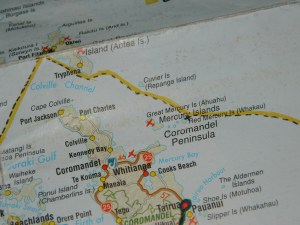
We have anchored at Red Mercury Island, just off the Coromandel Peninsula. DSCN0230We’re a bit sore, sleeping on benches and in corners like human Jenga. All our stuff is drenched as there is a crack in the hatch in the front of the boat – right above our bunk. But it’s an excuse to get the guitar out of its damp case. As the sun set, leaving scuds of brilliant red on the ‘Eye of Sauron’ horizon, we saw a couple of whales spraying up jets of water from their blowholes in the distance. Hopefully tonight we’ll hear some Morepork and Kiwi birds. A Morepork was flying around as we weighed anchor, and shortly after, something flew into the side of the boat in the darkness, letting out a terrible cry as it thudded! I hope it wasn’t the Morepork.
At night, just before bed, Kyle gets his best epiphanies. Cracking open another beer after a round of cards, we laugh, amused by his ramblings, half agreeing, if only we knew what he was talking about! Perhaps it’s just the remarks of a smoking capsicum.

Land Legs

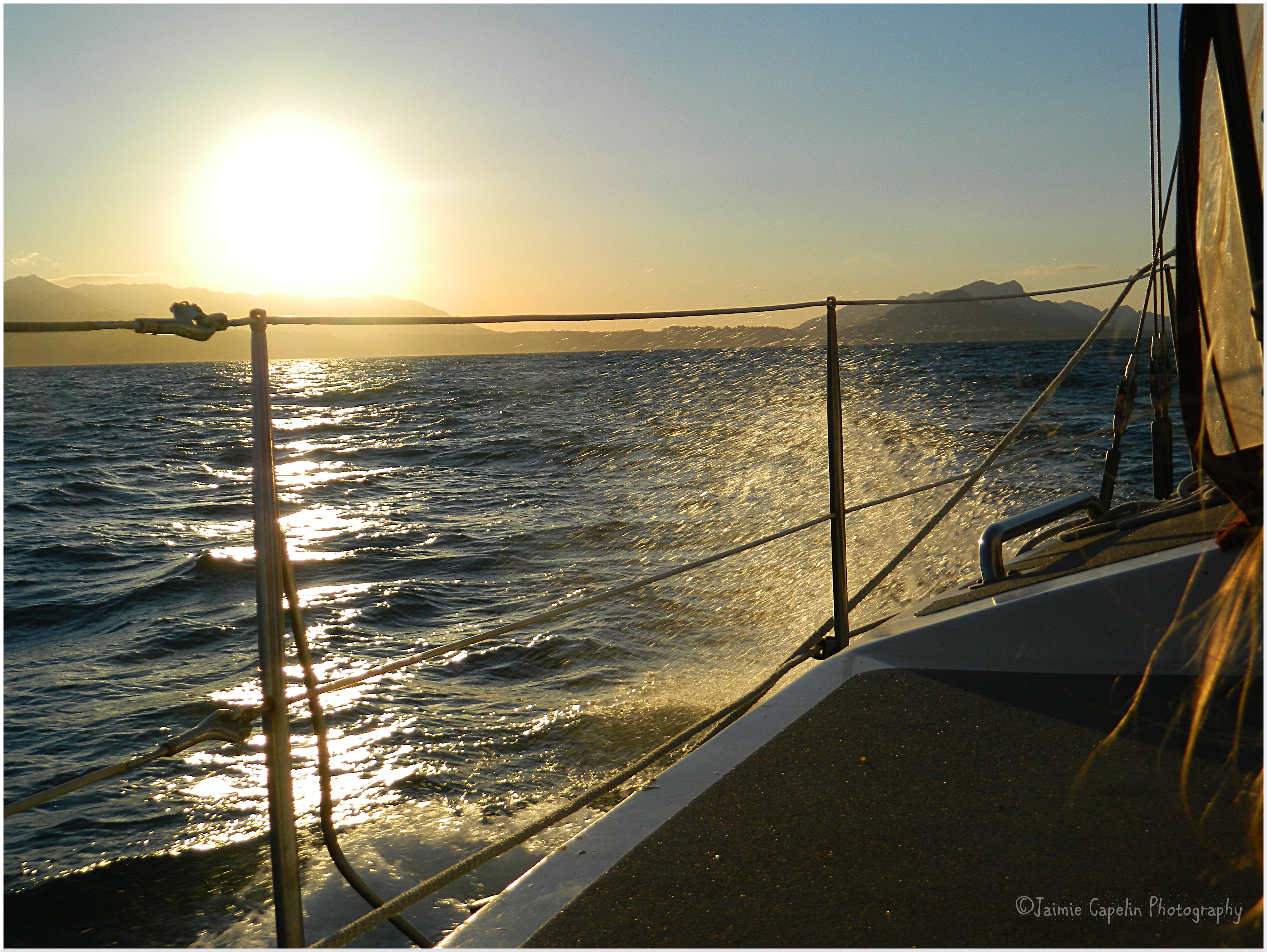
Day 5 of sailing. We left our little cove on Red Mercury Island after sunrise. All groggy and bleary eyed after a wet and noisy night of creaking and leaking hatches. The weather improved heaps and we passed the tip of Coromandel. Finn and Dani counted about 60 various islands we’ve passed, and there are more to come.

Golden Seaspray

Golden Seaspray

Luca has developed quite a love affair with raw ramen. We rarely see him without his hand in an open packet. It might be a serious addiction. I caught Simon playing the harmonica this morning when he thought no one could hear him. He was playing ‘Love Me Do’ by The Beatles, really beautifully. I then learnt that it is a ‘Mundharmonika’ in German, and ‘harmonika’ by itself means accordion.

After 4 or 5 hours of calm ocean bliss, Great Barrier Island is in our sights; its south coast straight ahead. Big green hills rolling up out of the sea, over a red-grey cliff, with little bays and coves everywhere, it’s another Jurassic Park.

We’ve sailed up around the west of the island, past Tryphena and into an inlet with yet more tiny islands. There were rocks of all shapes and sizes; some with big open caverns where the waves eroded the walls; some the shape of turtles. We passed miniature civilizations on the beach – just a wharf and a couple of boats tied up, no one around, and craypots dotted everywhere. Giant jellyfish with pink heads float by, tentacles like unravelling brains.

We turned starboard into a narrow harbour entrance to a hidden bay, sheltered by islands and headland all around. Smokehouse Bay.

Smokehouse Bay

Smokehouse Bay

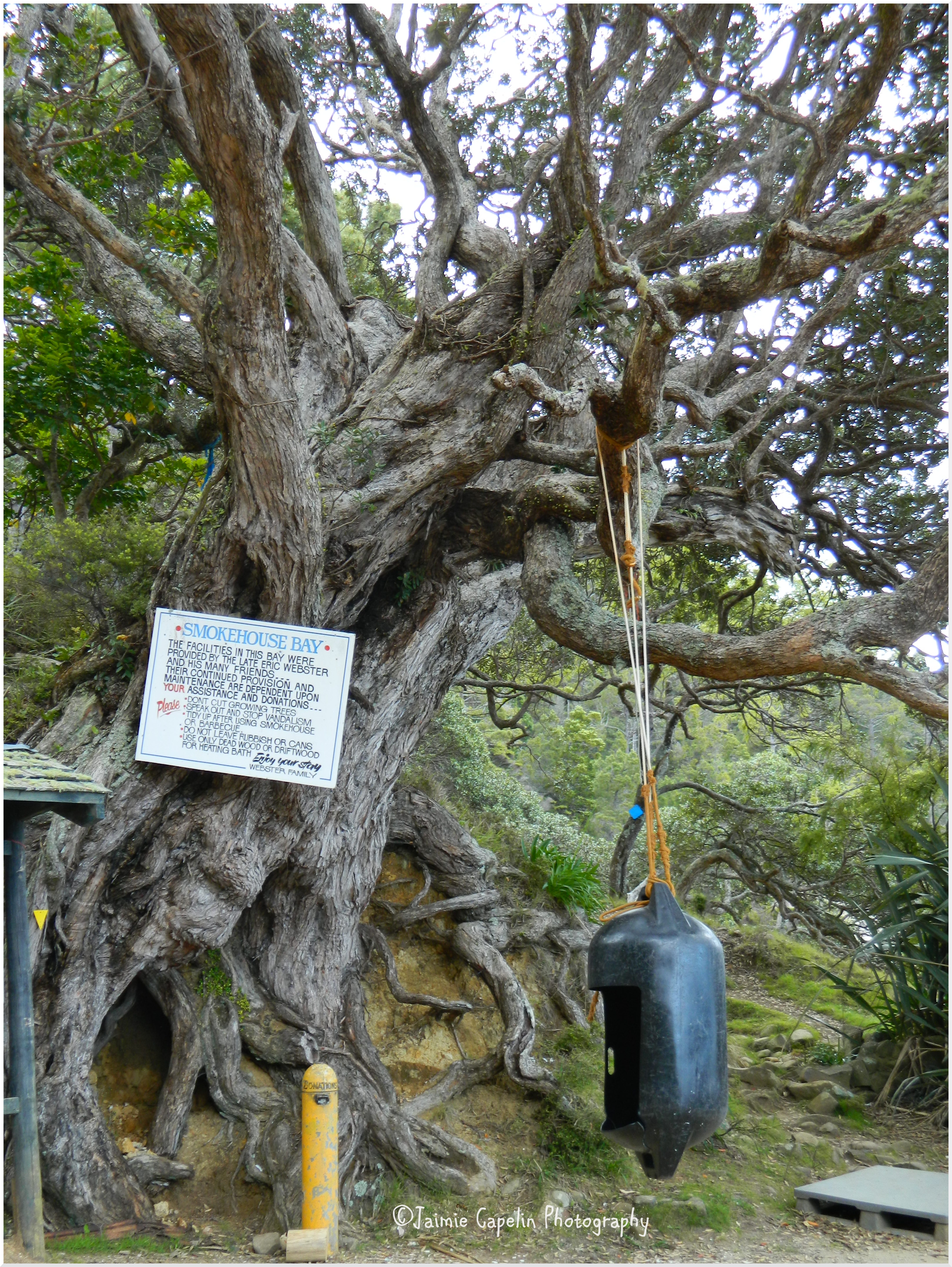
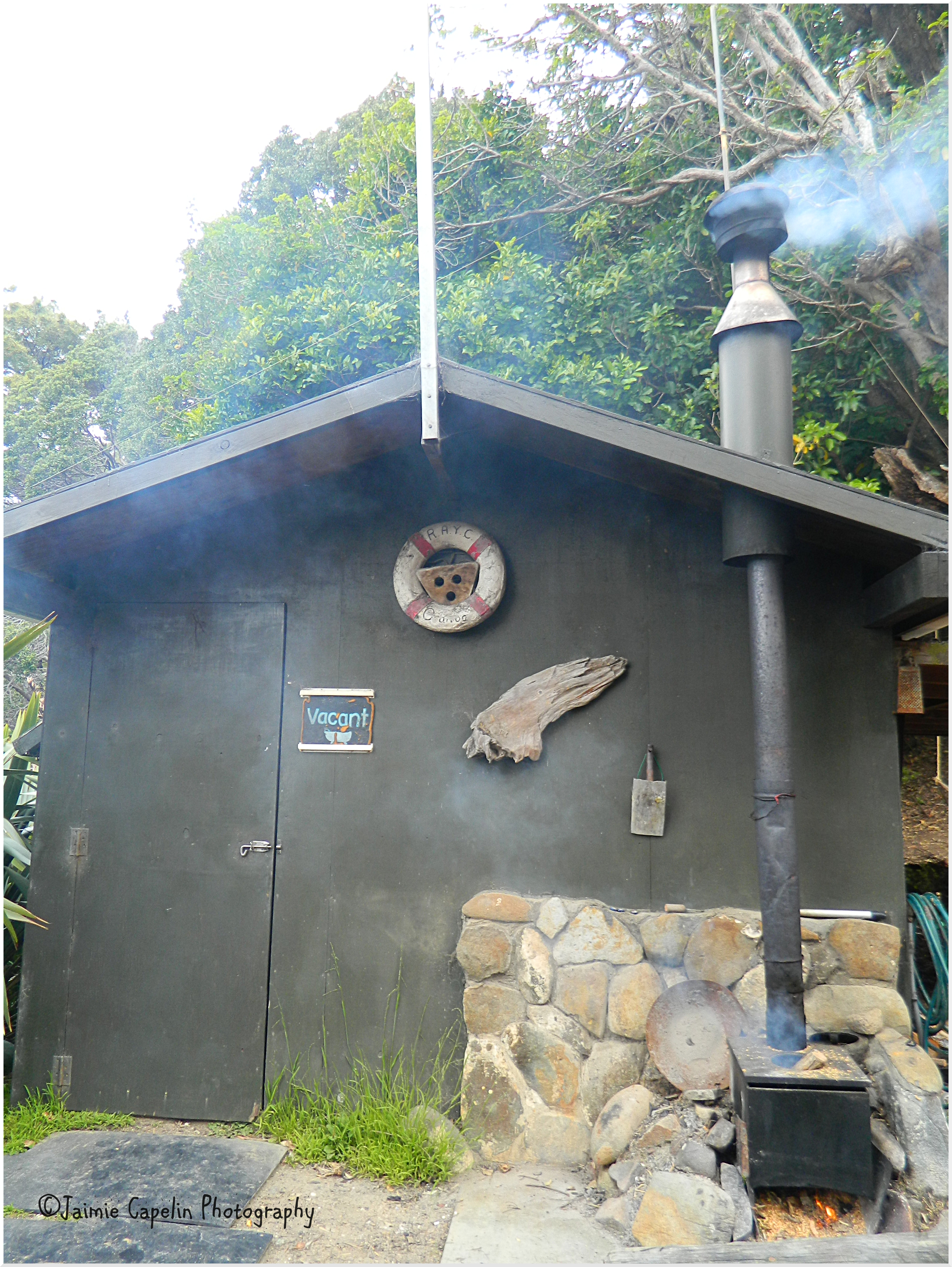
This is Finn’s favourite spot in the whole world.The bay has been adapted by sailors over the years, who built a smoke house for their fish. As

The Bath House

The Bath House

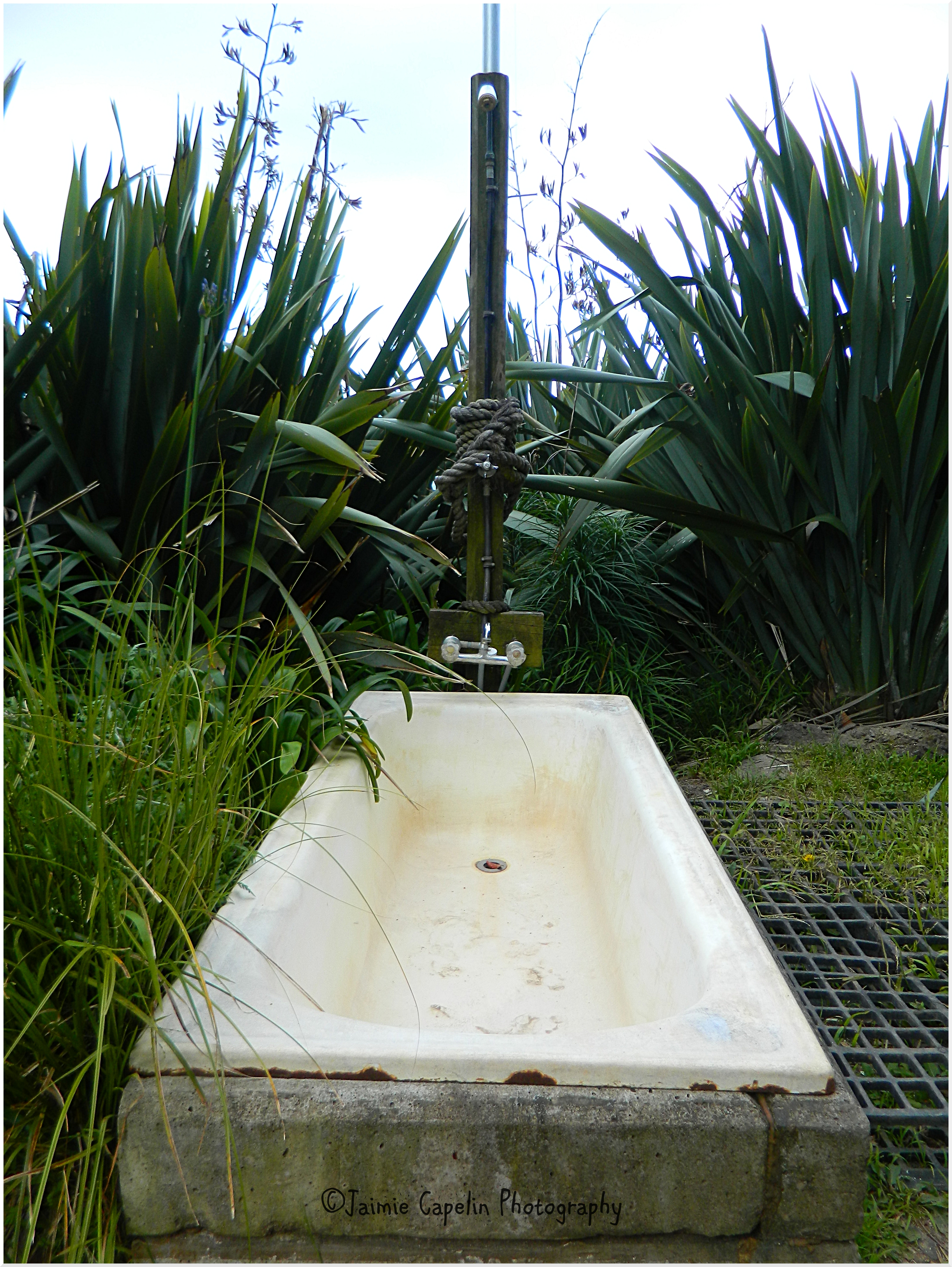
time went on, they built a wood-burner powered bath house, complete with bars of soap and

Beach Tub

Beach Tub

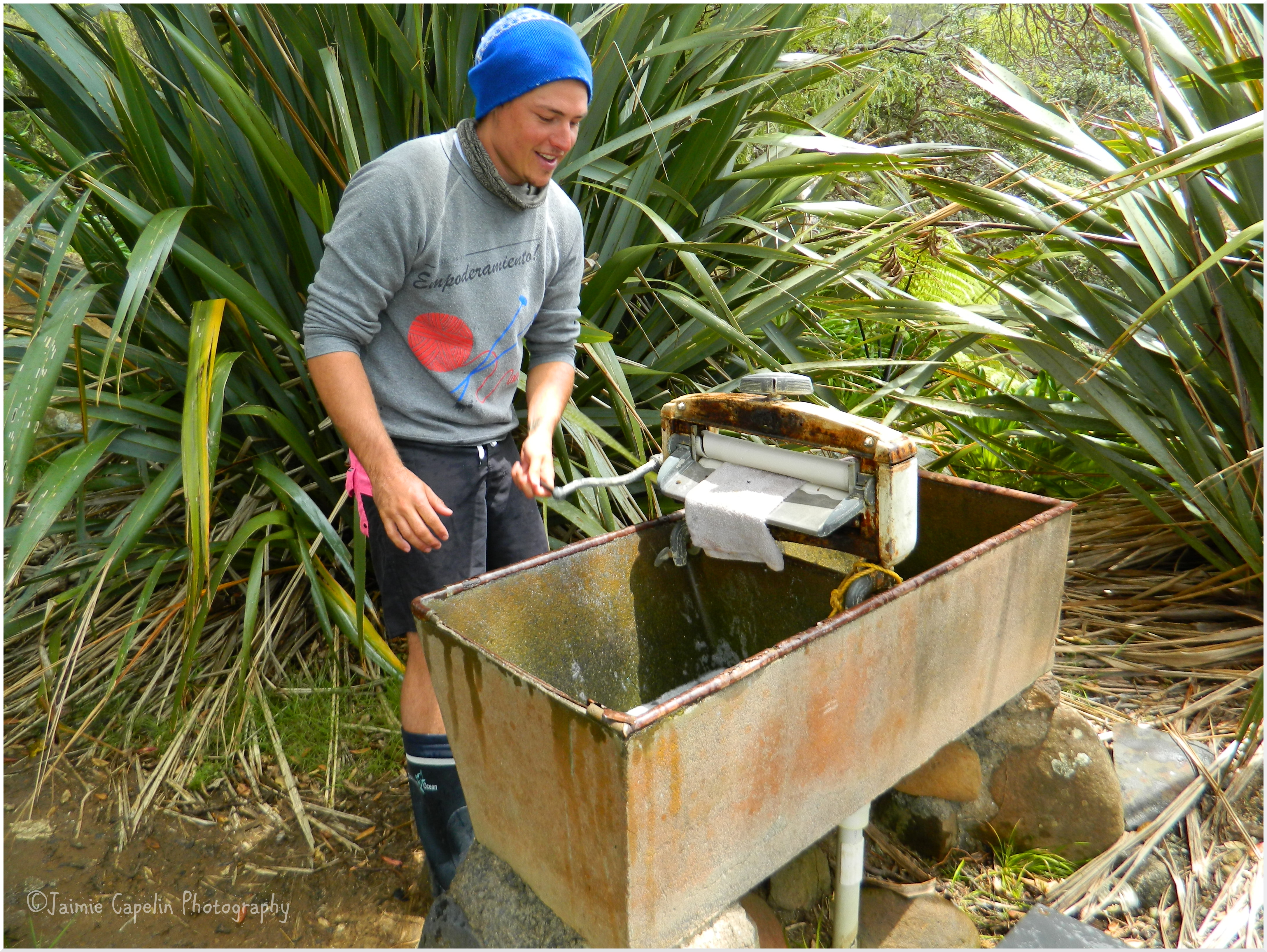
books to read, and even placed a set of mangles and washing lines along the shore to do their washing! There are homemade swings hanging from the Pohutukawa trees, and benches around a big fire pit. Even a long-drop loo nestles in the hill with a set of instructions on the door to keep it hygienic and natural.

Finn chopped some wood and got the wood-burner going and we took it in turns to shower, while sitting around the fire drinking beers. It was one of the best showers I’ve ever had. Straight from the spring in the cliffs, heated by woodfire, on a beach overlooking the coves of Great Barrier Island, in the middle of the Pacific. As I write, a Kereru has landed in the tree, a big clumsy pigeon, checking us out with his inquisitive sideways glance.

Seafood Seconds

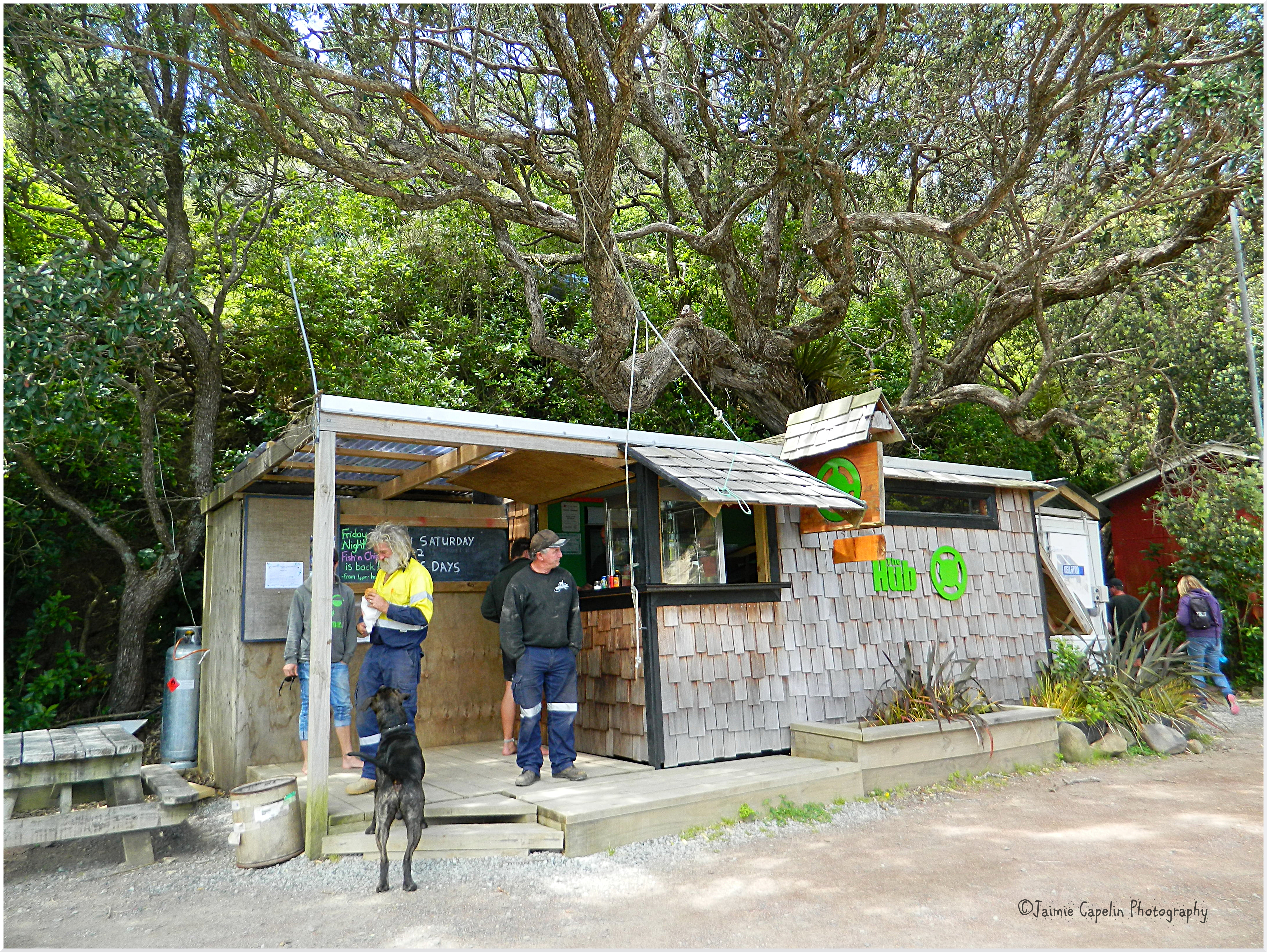
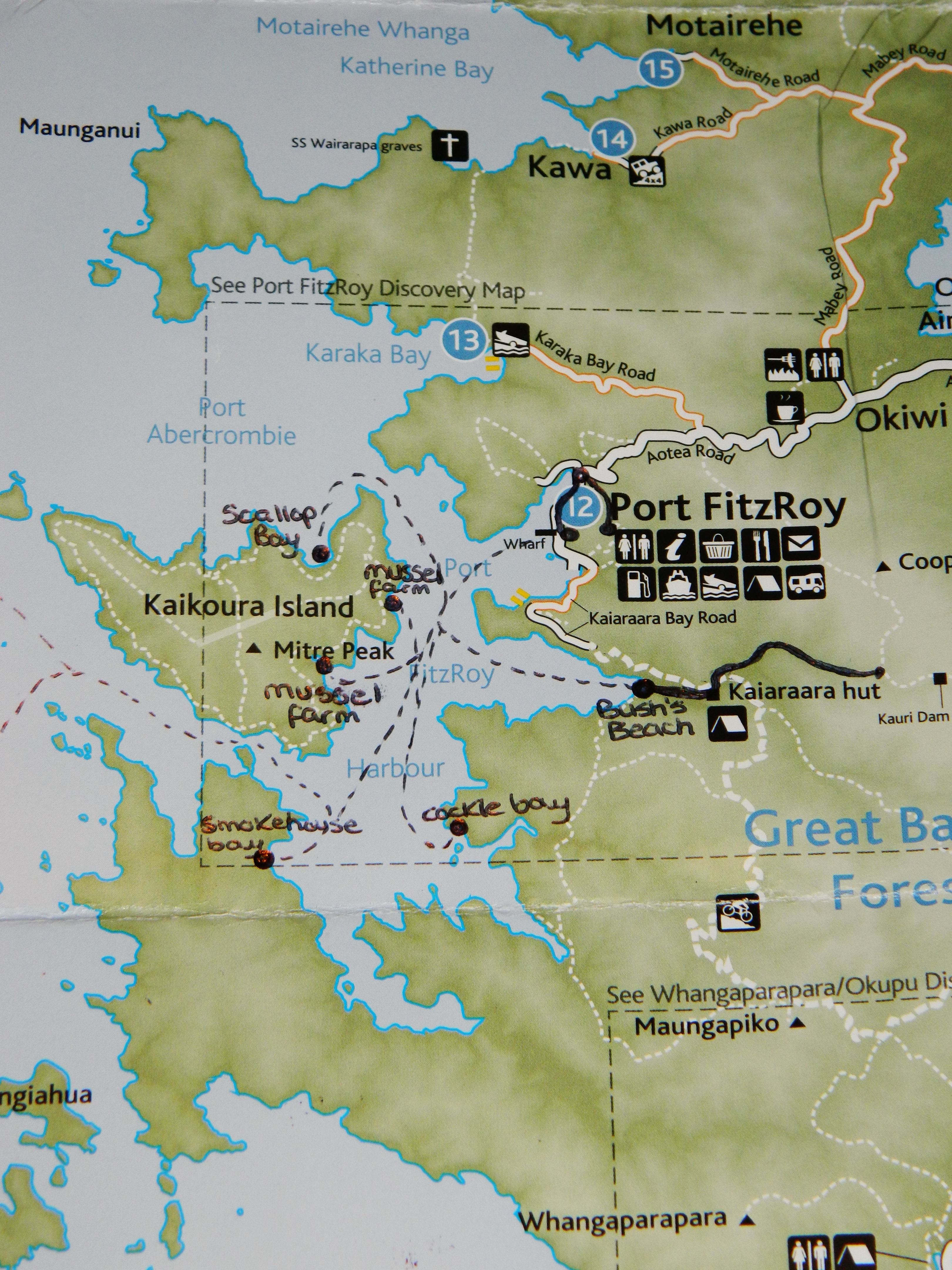
We made way to Port Fitzroy this morning, setting anchor and hanging around until the wharf was free to fill up our water tank. We took the dinghy to shore and the boys got chips and burgers from a little shack in the port called ‘The Hub’. The side of the hut is tied to a Pohutukawa tree and the hatch is on a winch over a branch to open and close it.

The Hub - Port Fitzroy

The Hub – Port Fitzroy

We watched as the car ferry from Auckland pulled in after its 6 hour crossing, and three people in an inflatable dinghy driving continuously into the side of it to no avail, presumably trying to push the ferry into port!

A short walk up the hill takes you to the Port Fitzroy shop – a humble little grocery store with fresh produce in baskets that doubles up as a bottle shop.

We attempted to go on a short walk to a waterfall, but an endless line of felled trees blocked the path. After climbing over a few of them – most of the guys barefoot – we decided to turn back. There were silver ferns and Koru and skeletal leaves all over the path.

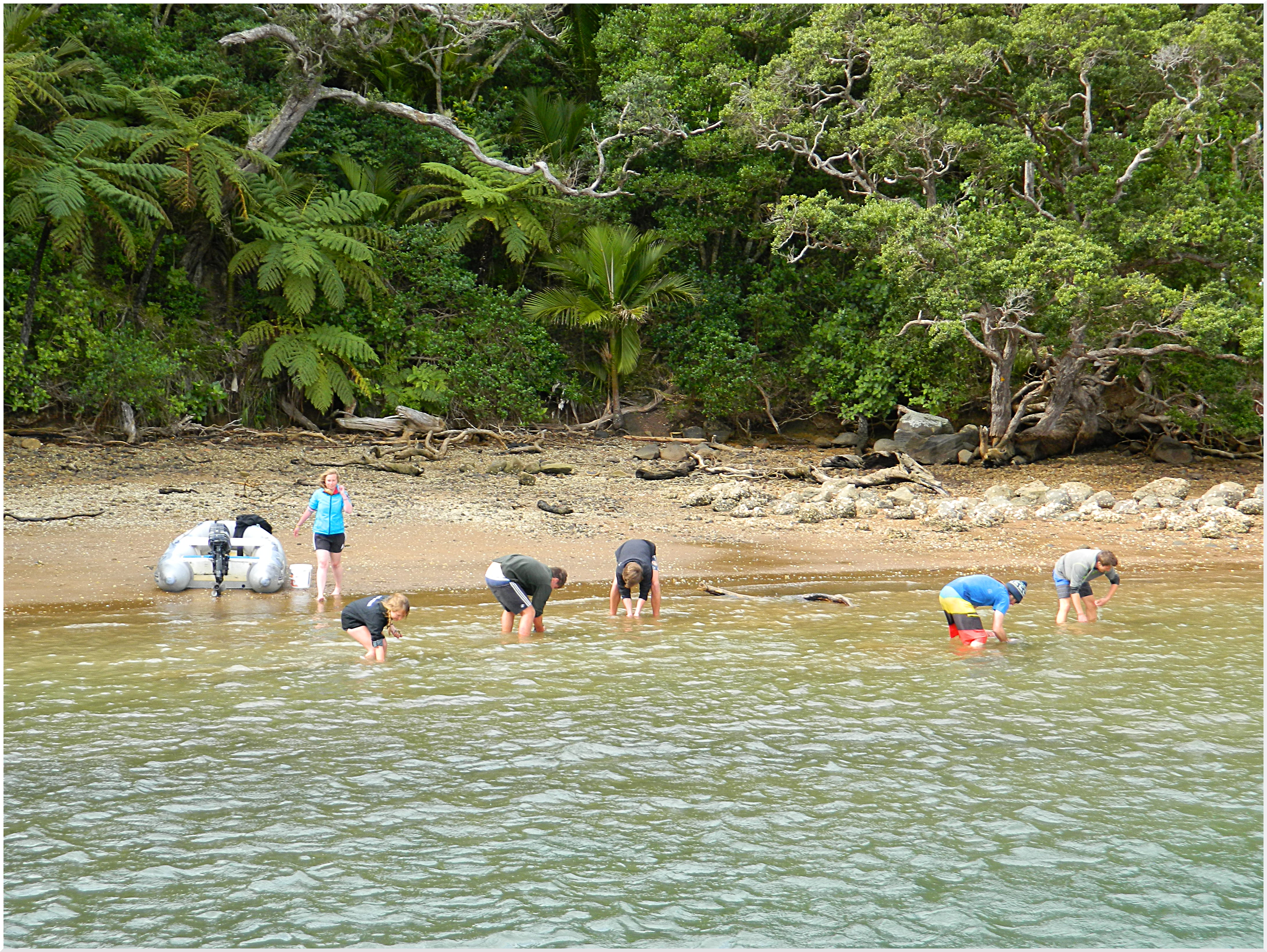
Cockling

Cockling

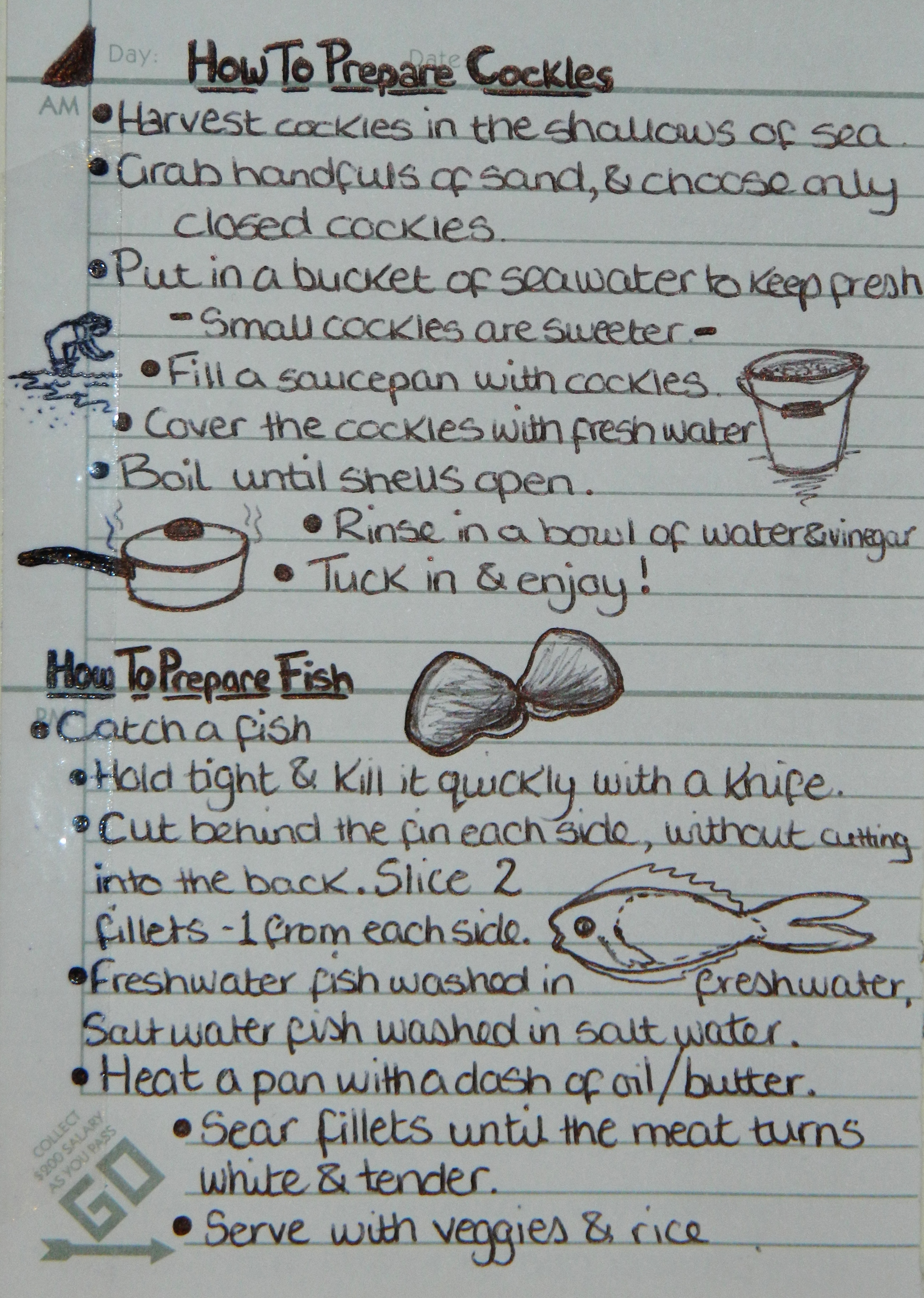
We filled the boat’s tanks with fresh water, got some groceries, and then motored down to the estuary to a bay filled with cockles. Putting on our stubbies, we climbed into the dinghy (or falling off it and getting wet in Fabian’s case) and went ashore. Up to our knees and elbows in the sea, foraging in the wet sand under water and picking out handfuls of cockles, we collected heaps in a big bucket of seawater to keep them fresh. We brought them back to the boat, cooked them in a big pot, and ate them on the deck, dipping them in vinegar and water. They were surprisingly flavoursome, even without seasoning.

DSCN9999(2)

Mussel Bay Rainbow


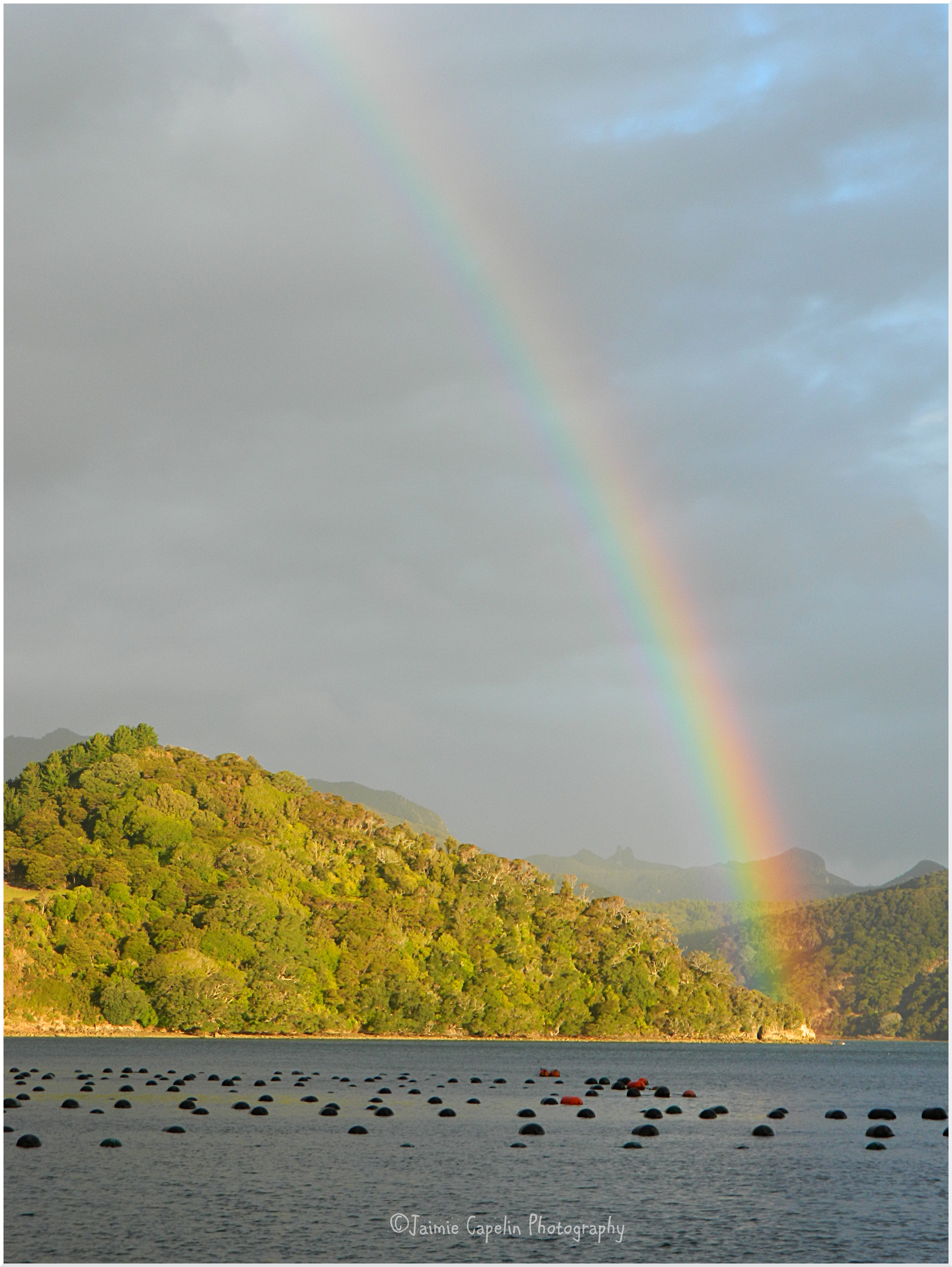
We’ve anchored on the inside coast of Kaikoura Island, where mussel farms litter the sea, and we spent the afternoon fishing beneath a double rainbow, arcing across the bay with both ends dipped in the sea. We were spoilt with the amount of fish; it was actually easy, and we threw at least half of them back in. I caught two Snapper; the first was young, so we threw him back, but the second was a biggun.

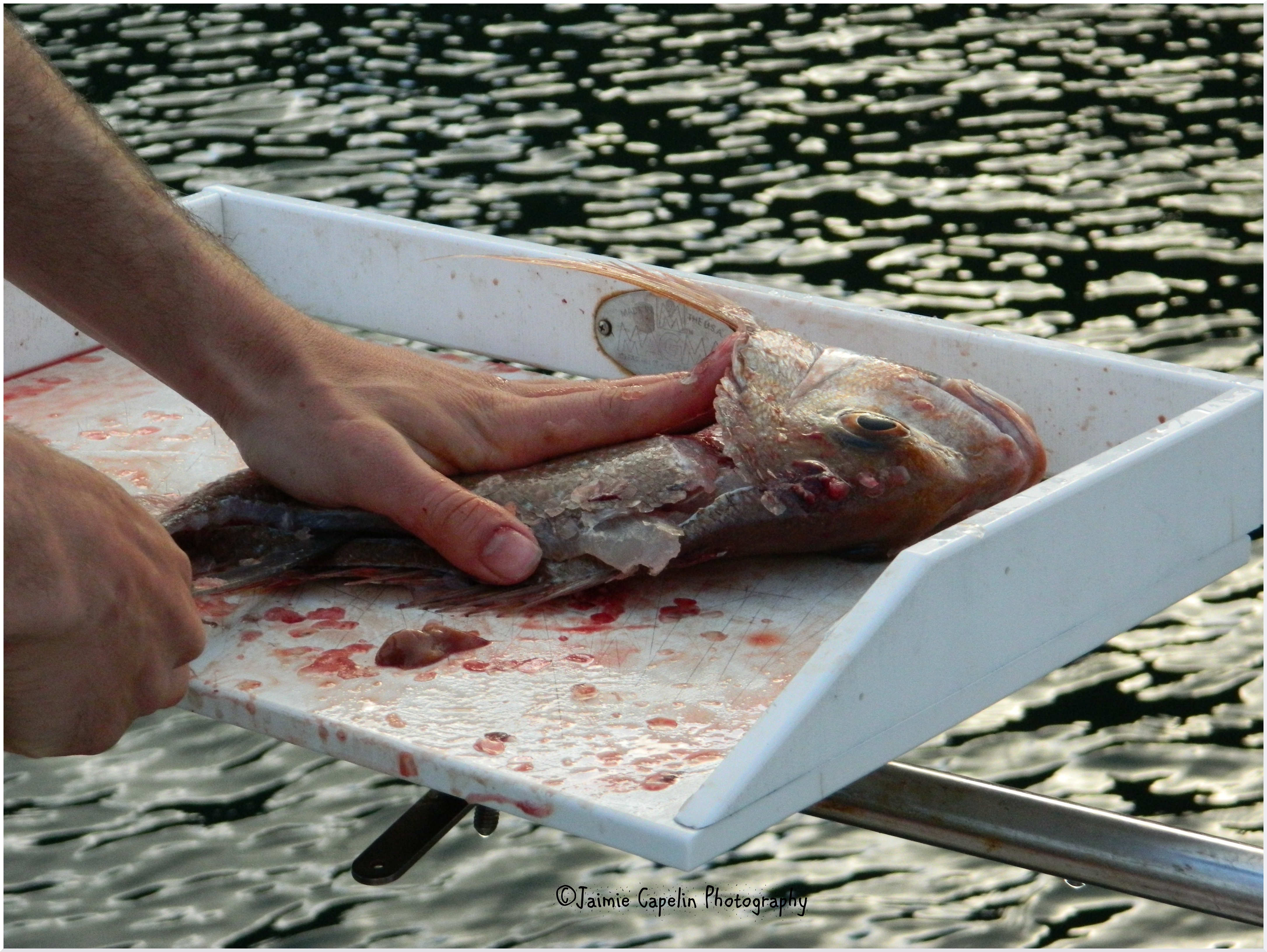
Gutting the Snapper

Gutting the Snapper


We ended up with 5 Snapper and 1 Trevally, which Fabian gutted and scaled.

He diced up about a third of the fish, marinating it raw in lemon and chilli, and then wrapped the pieces in spinach leaves for a sashimi entrée. The raw fish was so fresh it didn’t even taste like fish. Next he prepared pan-seared Snapper and Trevally with veggies and rice, which was delicious.


DSCN0214

Bath on the Beach

The weather had been on and off all morning, so our original plan to go on a hike was sabotaged. But Finn had gotten up early and caught a Kowhai fish, so after a quick stop at Port Fitzroy, we made way back to Smokehouse Bay. Fabian made some bread dough, which he put in the smokehouse to bake, and we still had some cockles left over, which we boiled in sugar water and smoked in the smokehouse. Finn basted his Kowhai in chilli, lime and brown sugar and smoked that too. The cockles were sweet and firm; the kowhai was rich and tender, it was all gone within seconds!

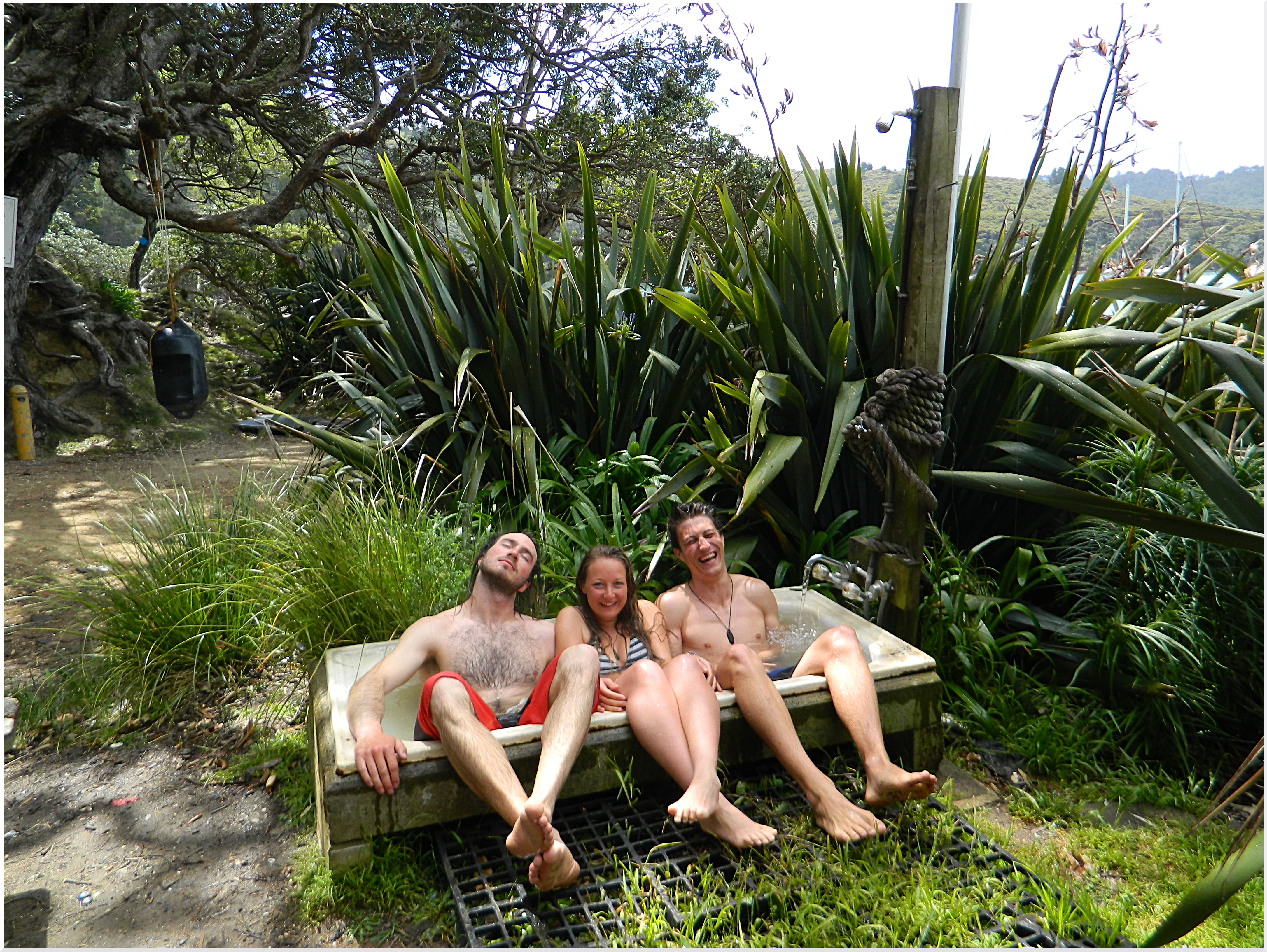
DSCN0010(2)Kyle washed the teatowels with the mangle and hung them out to dry, and we whiled away the hours talking and sheltering from the rain showers. Simon had the urge to run into the sea, so we turned the taps on in the outside bath tub, and we ran splashing into the water. The water was around 17/18˚c, and almost felt warmer than the air. We swam around for a bit, and when we got out, the bath was hot and ready, so Simon, Fabian and I got into the hot water and soaked. Sharing a bath on the beach, surrounded by flax, quite an odd but delightful thing!

DSCN0022(2)

Later we cooked some beef steaks on the fire, and took the bread out of the smokehouse. The bread had cooked well, but let me tell you, it tasted like fire! Soon, a couple arrived from their boat and we sat nattering to one another while they took turns to shower.

After the feed, Finn and Fabian took the dinghy and a battered surfboard they found washed up on the beach, and attempted to wakeboard. After 3 attempts of face-planting the sea, Fabian had it, slowly skimming around the bay, low in the water and passing the on-looking yachts so slowly it was comical. Next, Finn tried, but Fabian kept driving the dinghy round in circles, so they gave up and Finn had a bath. I found a copper teapot and made tea on the fire, but Finn had run out of hot water, so we ended up marinating him in the tea. He got out and joined us by the fire before things got too close to Lord of the Flies!

Some of the flax leaves at Smokehouse Bay have been plaited traditionally, and I tried to mimic the patterns. Flax were anciently used for weaving bags for hunting and gathering, and their strong fibres mean they are good for ropes. We sat around the fire, sipping tea and making jokes until the cold nestled in. We washed our utensils, tidied up, collected our washing and went back to the boat, where Finn cooked mini cheeseburgers and the guys played cards until they got sleepy.

The night was noisy – the anchor seemed to be trying to break free, and the tarpaulin we’d used to stop the rain coming in the hatch was flapping and knocking, but eventually, sleep came.

Hirakimatā Hike

DSCN0215

It was another late morning. After breakfast, we went to Bush’s Beach, where we took the dinghy to shore to go hiking. Finn stayed on board to do some maintenance, while the rest of us went to explore. Pulling up onto the little bay, we put on our hiking shoes and then realised the entrance to the track was blocked off by a red mesh fence and a sign saying, “WARNING – TRACK CLOSED”. We’d come this far, so we mutually agreed to jump the fence and see how far we could get. (Please do not follow this example!)

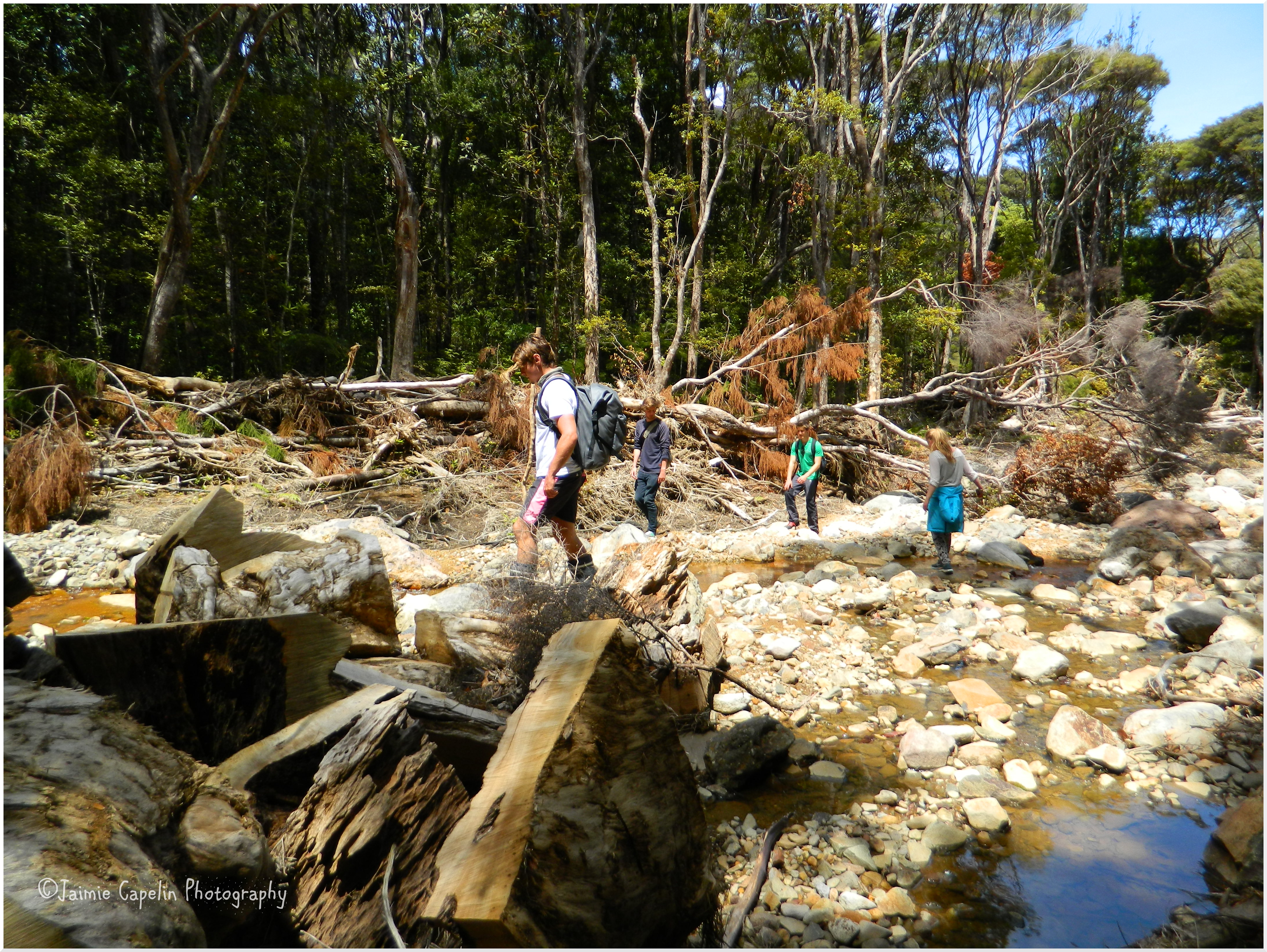
There were a few landslips as the track went up, through typical rainforest, silver ferns lining the path, and a river running down the gorge. We crossed the first two swing bridges, and came to where a third bridge should be. But it was gone, washed away down the river. The river had barely any water in it now, so we back-tracked, found a safe route down, and crossed the river by the rocks.


Collapsed Bridge - Bush's Beach Reserve

Collapsed Bridge – Bush’s Beach Reserve

On the other side, the path was demolished by a landslide, so we kept going until we were reunited with the path again. Eventually, we came to another bridge point with no bridge. Luckily the river was low, so again, we crossed it by foot pretty easily. Climbing higher and higher into the bush, the path suddenly disappeared off a sheer drop. A landslip had completely taken the path this time and there was no way around, so we turned back.

Simon and Dani made jokes, Kyle sang and yodelled while Luca snacked on ramen, and we detoured to a little pool in the river, where tiny waterfalls poured from. We all climbed a fallen tree that bridged over the pool, and Kyle jumped in. We hiked back down to the beach and went back to the boat.

This evening, Finn caught a Snapper in a Kaikoura Island cove, which we’re eating raw with soy sauce and wasabi.

Party at Smokehouse Bay

Around 7:30 am. The clouds cast a dull, grey coldness over the bay. Shorts and jumpers on, we all hop into the dinghy. Time to go cockling.

We foraged for some time until our bucket was brimming with cockles, Kyle humming ‘Silver bells & cockle shells’ all the while. A huge stingray lingered in the bay; a dark shadow darting about in the shallows.DSCN0240

Back to the boat with our loot, and we motored over to the mussel farm, where Finn fished. A young local boy was free diving from another boat, so Finn gave him $10 to dive down and get a bag of mussels. The kid brought an enormous bag up, and Kyle and Finn between them caught 7 Snapper! Now, with our seafood feast, we are heading back to Smokehouse Bay to prepare.

Chopping trees, starting the fires and getting the food ready; our hunting, gathering mission is well on its way to a party. Dani is quite the wood-chopper, with Luca helping with the kindling, and Fabian and Simon are washing and cracking the mussels ready to smoke. Fabian has filleted the Snapper, and I basted them in brown sugar, chilli and lime – Finn style. They’re also saving the egg sacks to try and make smoked caviar, which we have to guard from sneaky thieving seagulls.

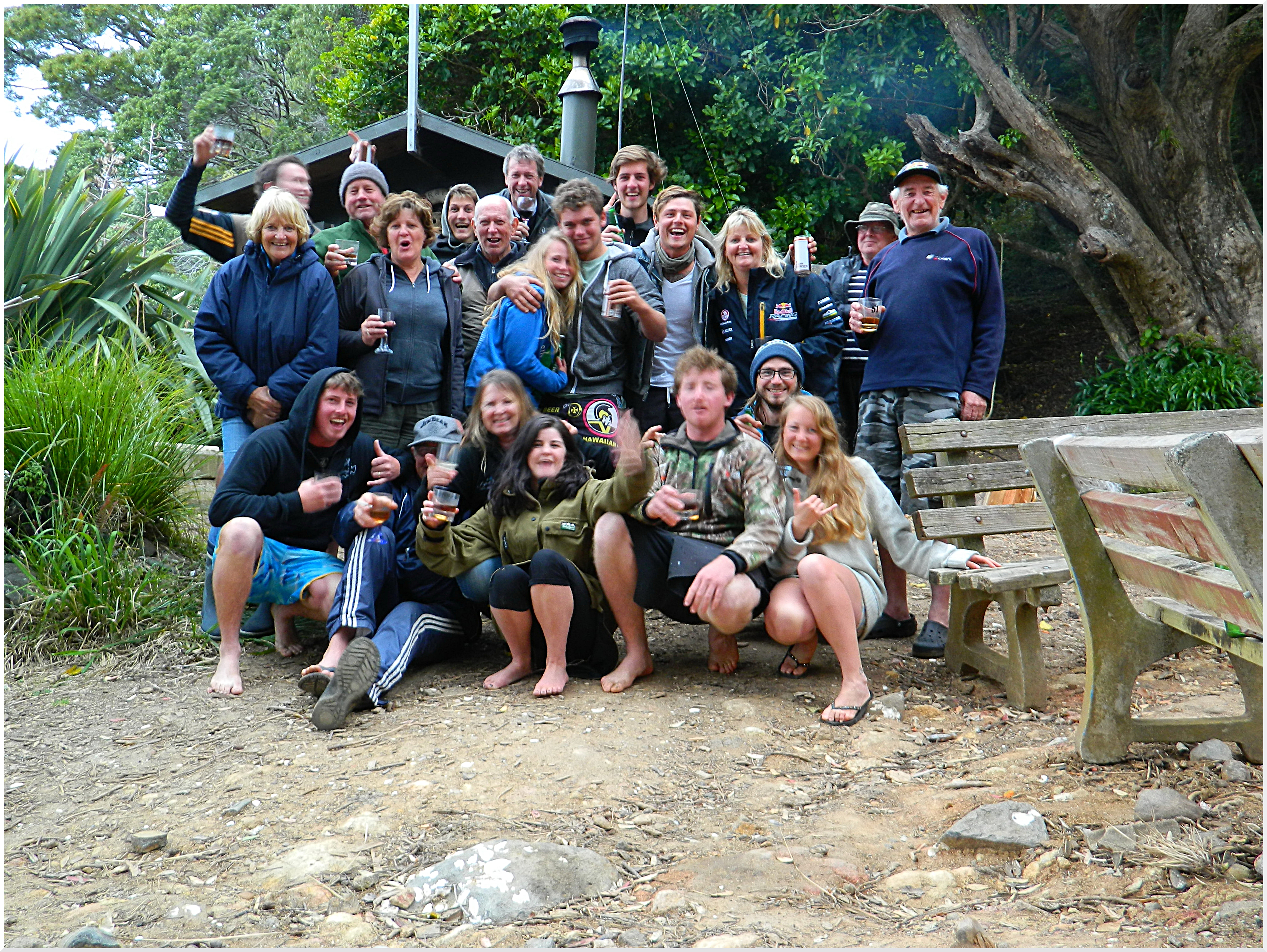
With all the cooking underway, we take it in turns to shower, and gradually the other boaties come ashore. There’s Captain Bill and the golden oldies from The Caramba, who’ve been coming here for 30/40 years and are so proud to have a new generation following in their footsteps. Then there is Geoff from Plymouth; a little mole-like man with round glasses and a proper Plymouth accent. Him and his wife sail a lovely little green yacht, which he has kitted out for their every need. Then there are the youngsters, Grace, Phillip, Sam and Brad from Christchurch and Hamilton, and their parents, all aboard The Shasa; a big fancy power boat. Phillip’s dad, Mark, is extremely kind – he brought us a crate of beer for going to the trouble of fishing and cooking.

We’ve shared around the cockles, mussels and Snapper, along with crisps donated by the others, and Captain Bill has raised toast after toast for appreciating such a beautiful place. They gave the name ‘Smokehouse’ a whole new meaning inside the bath house, and everyone is more than merry. Dani was forced to have a ‘Western Wash’ (her head dunked in the sea to sober up.) It didn’t work.

Party at Smokehouse Bay

Party at Smokehouse Bay

The party continued on the boats into the night – steak and beers on The Shasa, and Rum and music on The Dulcinea – sailors all chanting, “I’m on a Boat” by The Lonely Island, until we were so worn out, we crawled into our blankets and fell asleep.

DSCN0217

Snorkelling and Scallops

A stunning morning greeted our heavy heads, and we began the day by jumping off the back of the boat into the cool, refreshing sea. Finn cooked egg fried rice with bacon for brunch, which hit the spot, and we shared the last cans of coke, waving as the other boats slowly awoke to enjoy the warm sun.

I steered the boat as we headed over to another bay on the north of Kaikoura Island. The wheel feels heavy, and I can imagine how much hard work it is to steer in real weather and waves.

Bringing up the Scallops

Bringing up the Scallops

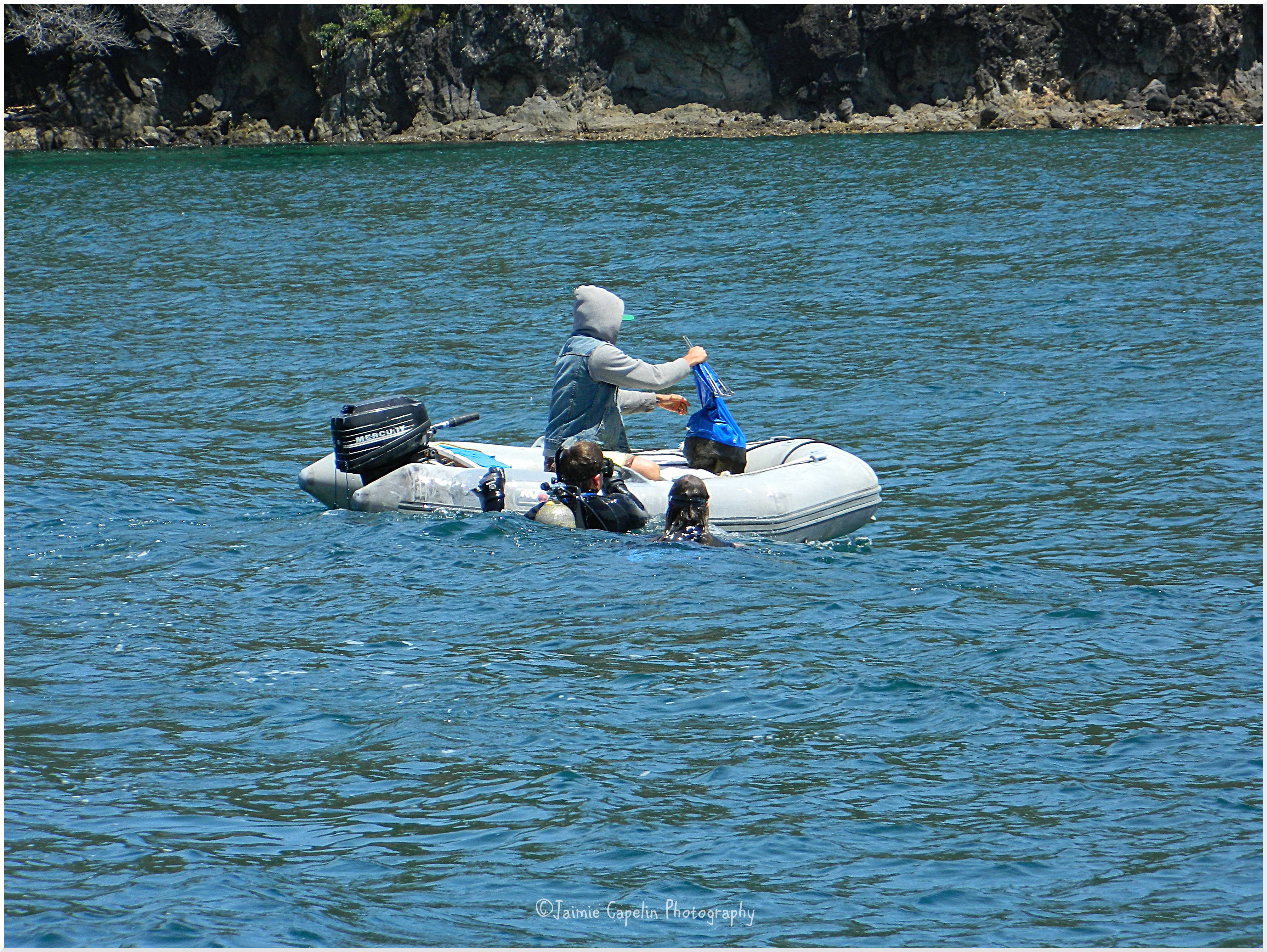
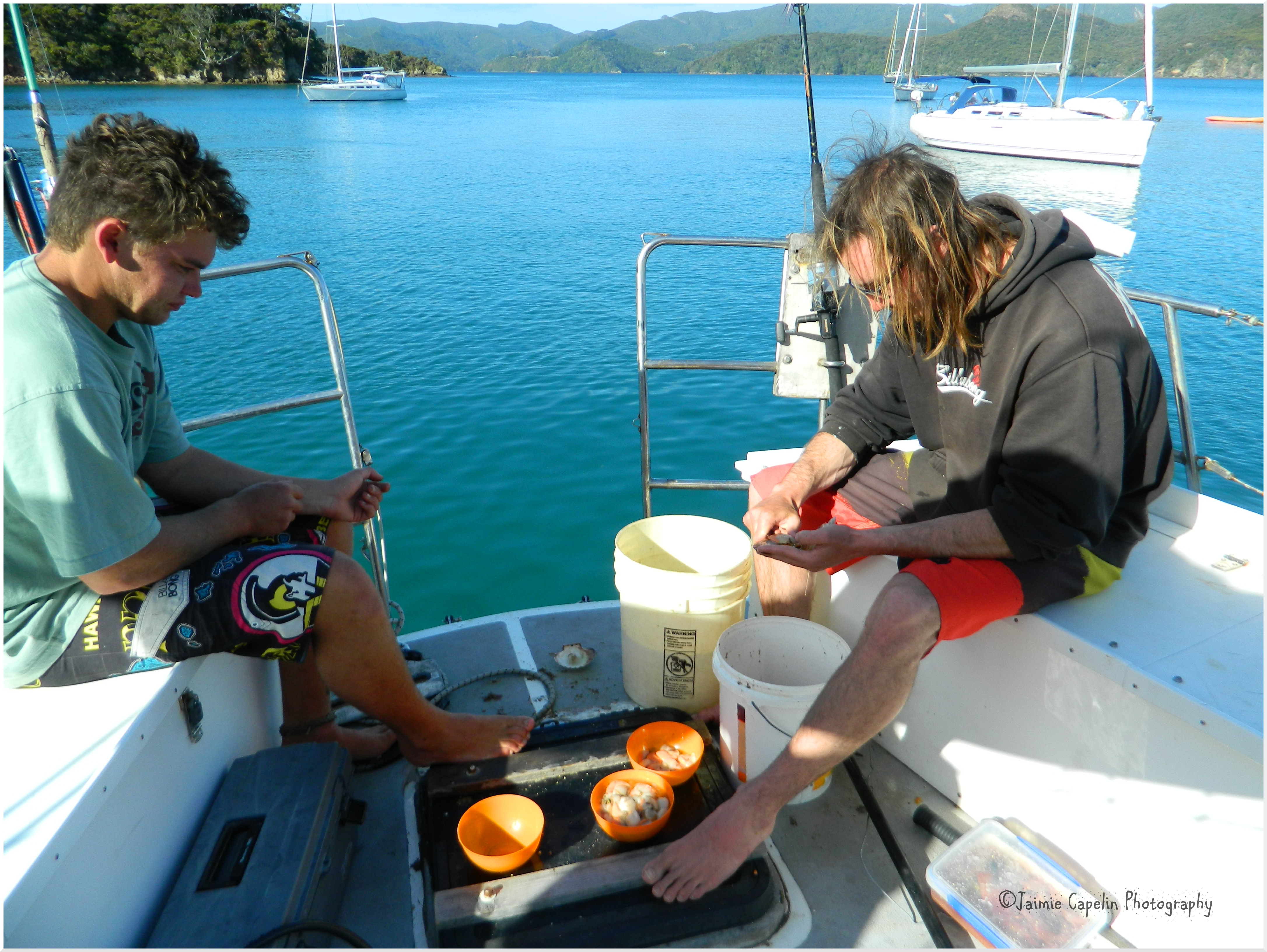
We anchored up and Finn got his scuba diving gear on, with a tank borrowed from Captain Bill, and went diving for scallops. Luca and Fabian went snorkelling too, while the rest of us were “ground control” – watching for bubbles to make sure Finn was still breathing!

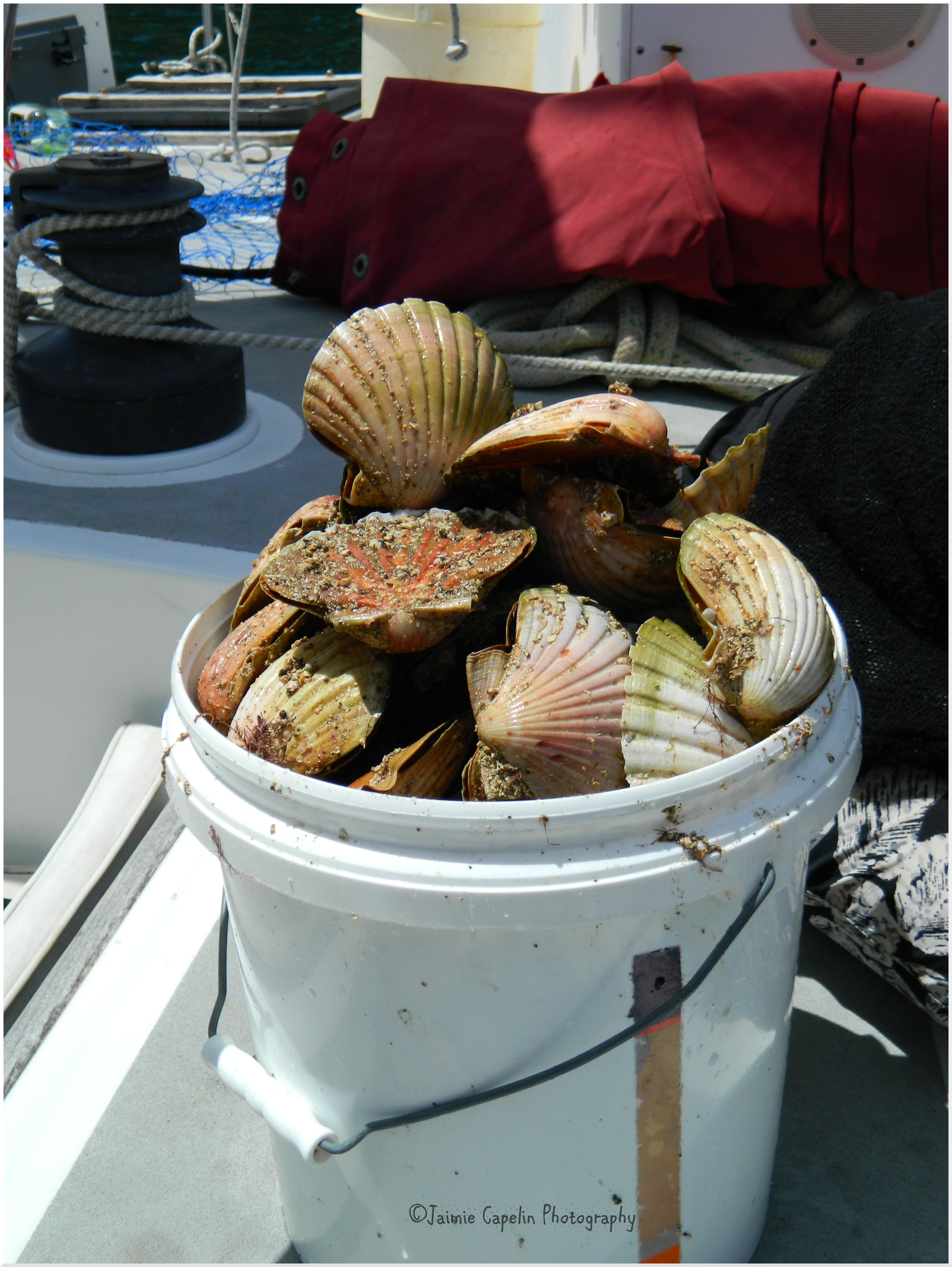
He finally popped his head up, shouting and beckoning, so Kyle jetted over in the dinghy and brought back a huge bucket of scallops. Finn was so excited; he cracked one open right away and ate it raw, trying to persuade us to eat them too. Kyle suggested he’d come up to surface too quickly and the air had gone to his head.

DSCN0107(2)

Freshly Harvested Scallops

The Fishermen’s Feast

Back in the bay, Captain Bill came over to get his air tank, and sat on the deck with Finn and Fabian, showing them how to properly fillet the

Preparing the Feast

Preparing the Feast

scallops. Fabian then prepared them with curry powder and made spaghetti with onions and herbs – “Great Barrier Bolognese.”

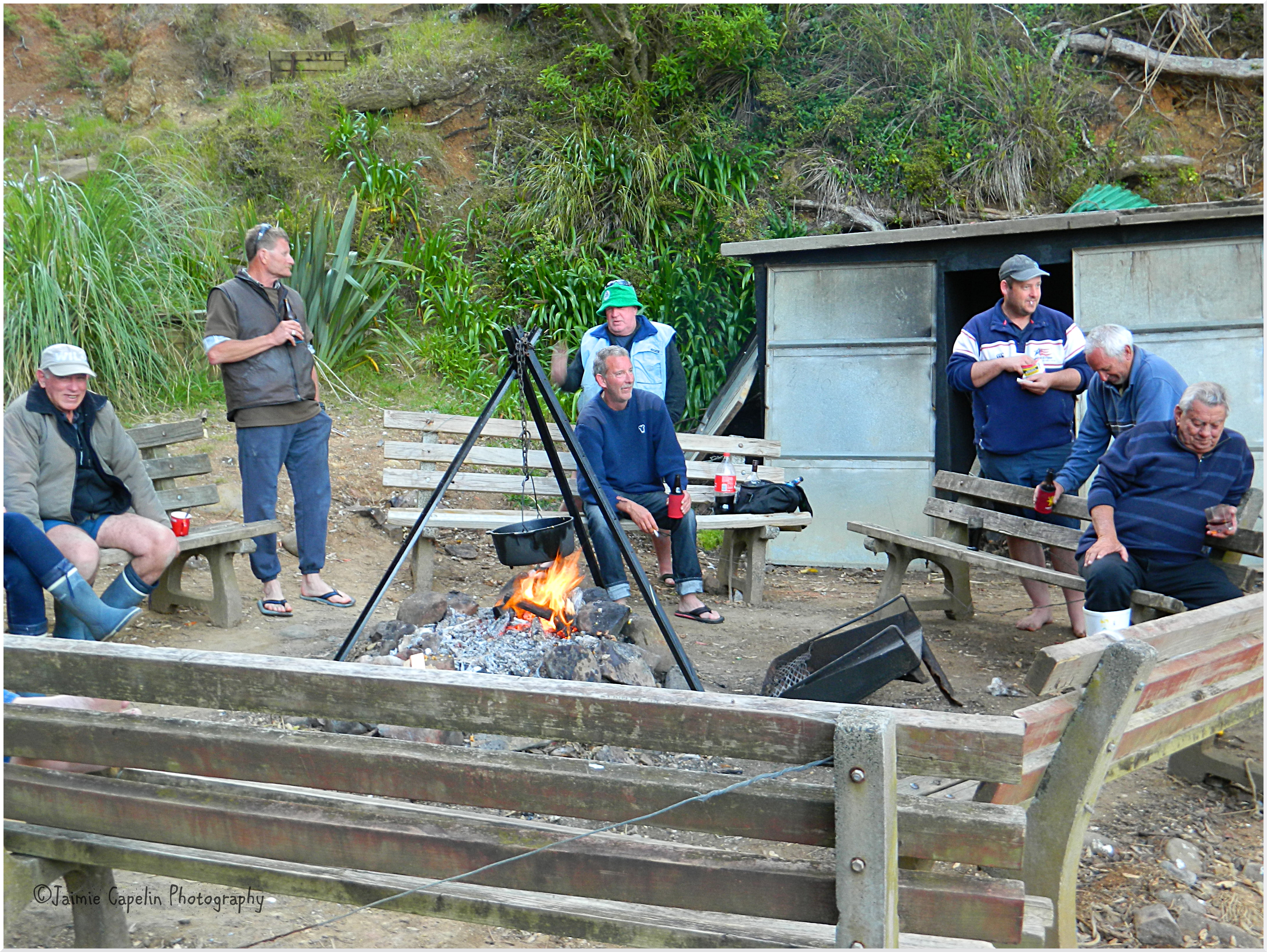
We took the food to Smokehouse Bay, where the old boys had already begun the feast. A few boats from a sailing club had got together with freshly caught Snapper and a washing-up bowl full of batter. They battered and cooked the fish in a cast iron pot hanging over the fire. The folks from The Caramba made a beautiful fish curry with Snapper and Porai they’d caught, and we all shared our feasts, complimenting each other.

Battered Fish Cooking over the Fire

Battered Fish Cooking over the Fire

One of the old boys explained how the Porai fish was always the one the Maori chief got first pick of, so it’s pretty special. We ate, trying everything, the other boaties being so generous and welcoming, offering us their food for our hungry young German boys! Fabian’s Great Barrier Bolognese went down a treat with everyone.

Full and content, we went back to the boat for an early night, leaving the party to unravel on the beach.


To The City

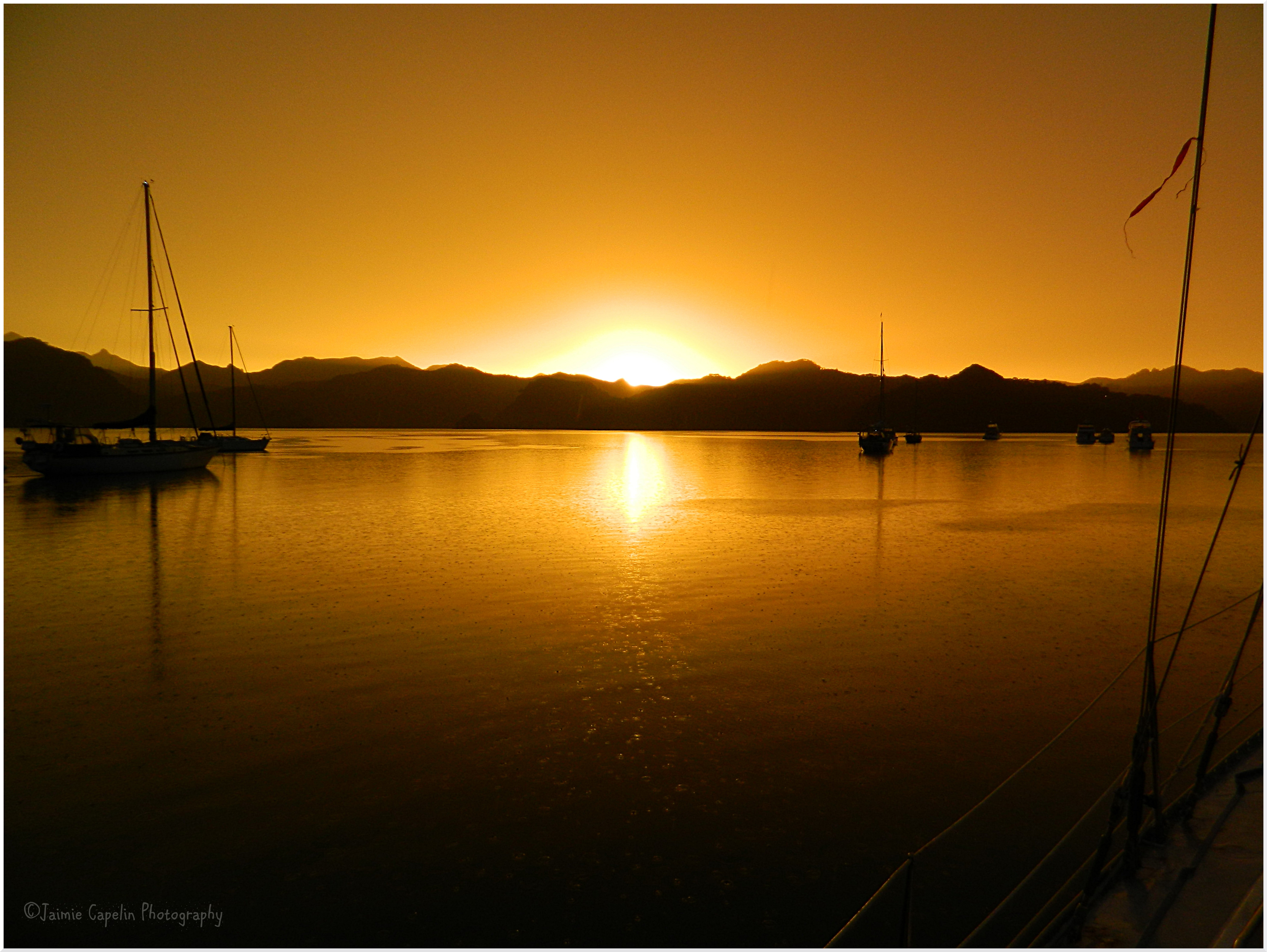
A gold leaf sunrise at Smokehouse Bay, raindrops decorating the glassy sea, everything washed in a shade of ochre yellow.

Sunrise at Smokehouse Bay

Sunrise at Smokehouse Bay

The final leg of the journey threw wind and rain at us, Finn and Kyle in all their waterproof gear, sailing hard into the weather while the waves smashed the boat from side to side. Meanwhile below, we played heavy music that seemed fitting to the weather outside. Dani braided bracelets while Simon & Luca drifted in and out of sleep, and Fabian successfully challenged himself to build a house of cards. The boys outside saw blue sharks and epic cloud-drifted scenes, washed with rain.

DSCN0233

We all stood out on deck approaching Auckland, the grey city spiking the low cloud. Rain soaked us as we slowly came into civilization, cranes working fast to load cargo onto enormous ships; catamarans zooming back and forth, carrying passengers across the water; bank names labelling the skyline, and the sky city tower barely visible in the cloud. We berthed at the marina, and with feet back on (slightly damp) land, it was to The Swashbucklers Inn for a welcome pint.

Journey's End

Journey’s End